
Contractor Payments
Choosing the Best Payment Platform for Contractors in 2026
Finding the right payment platform for contractors is about more than just swiping a card; it is about protecting your hard-earned profit margins from hidden fees and chargebacks.

A payment platform for contractors needs to be as mobile and rugged as the crew on a job site. Whether you are running a plumbing business in Alabama or a landscaping company on the coast, how you get paid determines your actual take-home pay. Many contractors start out using simple apps on their phones, but as the business grows, those high flat-rate fees start to bite into the bottom line. If you want to see a full comparison of top providers, you should read our deep dive into the best payment processing for contractors to see which brands lead the pack. In this guide, we will look at the mechanics of merchant accounts, how to avoid common fee traps, and how to use modern technology to keep more of every dollar you earn.
How to Choose the Right Payment Platform for Contractors
When you are looking for a payment platform for contractors, you have two main choices: a third-party aggregator or a dedicated merchant account. Aggregators like Square or PayPal are easy to set up, but they often charge a high flat rate, usually around 2.6% to 3.5% per transaction. For a contractor doing large projects like roof replacements or kitchen remodels, those percentages add up to thousands of dollars a year. A dedicated merchant account, like what we provide at PayWavez, gives you more stability and lower rates because the account is underwritten specifically for your business risk level. This means fewer sudden account freezes and more transparent pricing. You can even see how this works in person with a live demo of our systems.
Key Takeaway: Contractors who switch from flat-rate aggregators to an interchange-plus merchant account often save 20% to 30% on their total monthly processing costs.
Understanding Credit Card Processing Fees
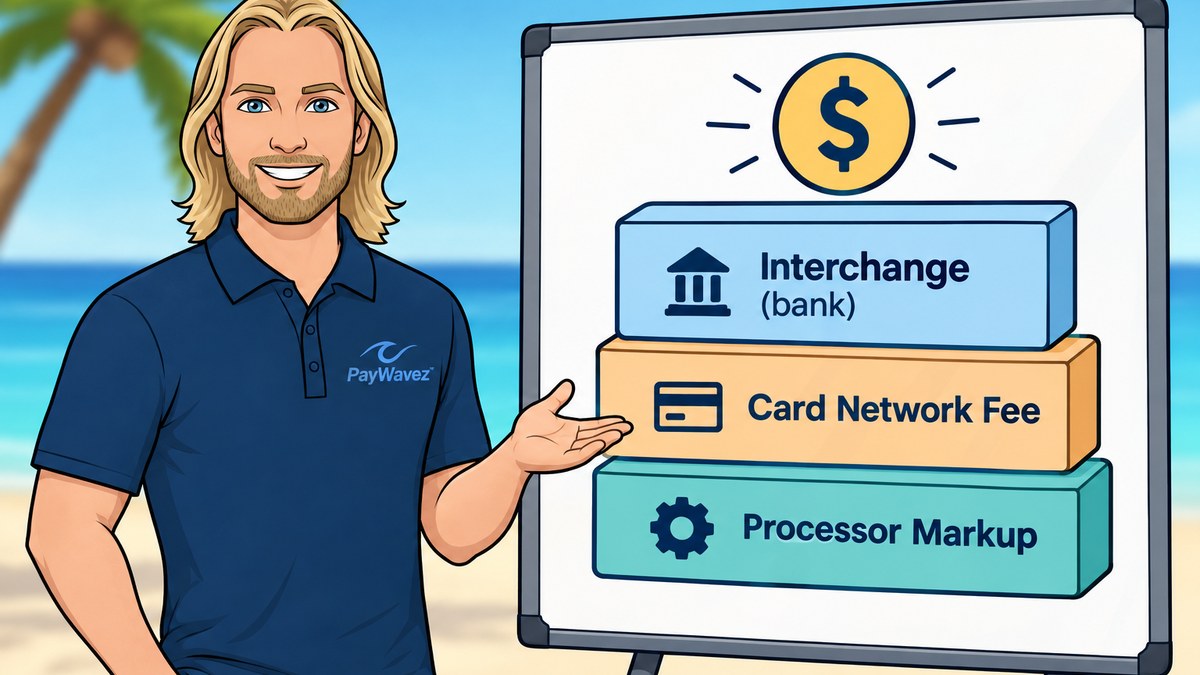
Most contractors see a single number on their statement and assume that is what they pay. In reality, that number is made up of several parts. The biggest chunk is the interchange fee, which goes to the bank that issued the customer's card. Then there are assessment fees from the card brands (Visa, Mastercard) and finally the processor's markup. If you are a local business looking for Alabama payment processing, you need a partner who explains these fees clearly. Avoid "tiered pricing," which hides the true cost of cards by bucketing them into "qualified" and "non-qualified" groups. Instead, look for interchange-plus pricing, where you pay the raw cost of the card plus a small, fixed margin. This transparency is the only way to ensure you aren't being overcharged for rewards cards or corporate cards, which are common in the construction industry.
The Power of Surcharging and Cash Discounts
One of the most effective ways to lower your costs is through a surcharging or cash discount program. Surcharging allows you to pass the credit card processing fee directly to the customer. For example, if a job costs $5,000, the customer can pay by check or cash for that price, or they can choose to pay by credit card and cover the 3% fee themselves. This is completely legal in most states as long as you follow specific signage and disclosure rules. A cash discount program works similarly but frames the lower price as a discount for not using a card. This is a game-changer for service businesses with tight margins. By implementing these programs, many of our clients in areas like Gulf Shores have seen their processing bills drop to nearly zero.
"Contractors shouldn't have to choose between the convenience of accepting credit cards and the reality of keeping their profit margins intact."
Mobile Terminals and Field POS Systems
Contractors are rarely behind a desk. You need a payment platform that works on the tailgate of a truck or inside a customer's home. Modern smart terminals, like the Clover Flex or specialized Dejavoo units, allow you to take payments via chip, tap, or swipe anywhere there is a cellular or Wi-Fi signal. These devices are much more secure than the old-fashioned "dongles" that plug into a headphone jack. They provide a professional experience for the customer and can even print a receipt or email it on the spot. Using a dedicated terminal also helps reduce the risk of "card-not-present" fraud, which carries higher fees and a higher risk of chargebacks. When the card is physically present and the chip is read, you are protected by EMV liability rules.
Managing Chargebacks in the Construction Industry
Chargebacks are a major headache for contractors. A customer might dispute a charge because they aren't happy with the work or because they don't recognize the business name on their statement. To prevent this, your payment platform for contractors should allow you to customize your "doing business as" (DBA) name so it matches what is on your trucks and contracts. Always get a signed contract and a signed completion certificate before running the final payment. If a dispute does happen, having a dedicated merchant account representative makes a huge difference. At PayWavez, we help our clients fight unfair chargebacks by providing the documentation needed to prove the service was rendered as described.
PCI Compliance and Security for Small Businesses
Security isn't just for big retailers. Every business that accepts cards must be PCI (Payment Card Industry) compliant. This means following a set of security standards to protect customer data. Many small contractors get hit with "non-compliance fees" on their monthly statements because they haven't filled out their annual self-assessment questionnaire. A good payment partner will walk you through this process so you can avoid those $20 to $50 monthly penalties. Modern terminals handle most of the security for you by encrypting the data the moment the card touches the machine, ensuring that sensitive info never actually touches your phone or computer system.
Conclusion: Making the Best Choice for Your Business
Choosing the right payment platform for contractors is a strategic decision that affects your cash flow and your sanity. Don't settle for high flat rates or processors that don't answer the phone when you have a question. Look for a partner that offers transparent pricing, rugged mobile hardware, and the ability to pass fees to the customer legally. If you are ready to stop overpaying, remember to check our earlier guide on the best payment processing for contractors for a closer look at the options. Your hard work deserves to be rewarded with full profit, not drained by unnecessary fees.
Ready to see your own numbers?
Run your real card volume through the calculator or apply in about two minutes.