
Fees & Rates
What Are Credit Card Transaction Fees? A Guide to Merchant Costs
Credit card transaction fees are the costs a business pays to accept card payments, typically ranging from 1.5% to 3.5% per sale. Understanding how these fees are split between banks, card networks, and your processor is the first step to lowering your monthly bill.

When you look at your monthly merchant statement, it can feel like you are reading a different language. Between the acronyms and the long lists of numbers, it is hard to tell if you are getting a fair deal or being overcharged. Most business owners know they have to pay to accept plastic, but they don't always know where that money goes.
Before diving into the fine print, it is important to know that you have options for managing these costs. For example, many businesses are now choosing to pass credit card processing fees charged to customers directly to the cardholder to protect their profit margins. This can effectively bring your processing cost down to near zero.
The Three Layers of Every Transaction
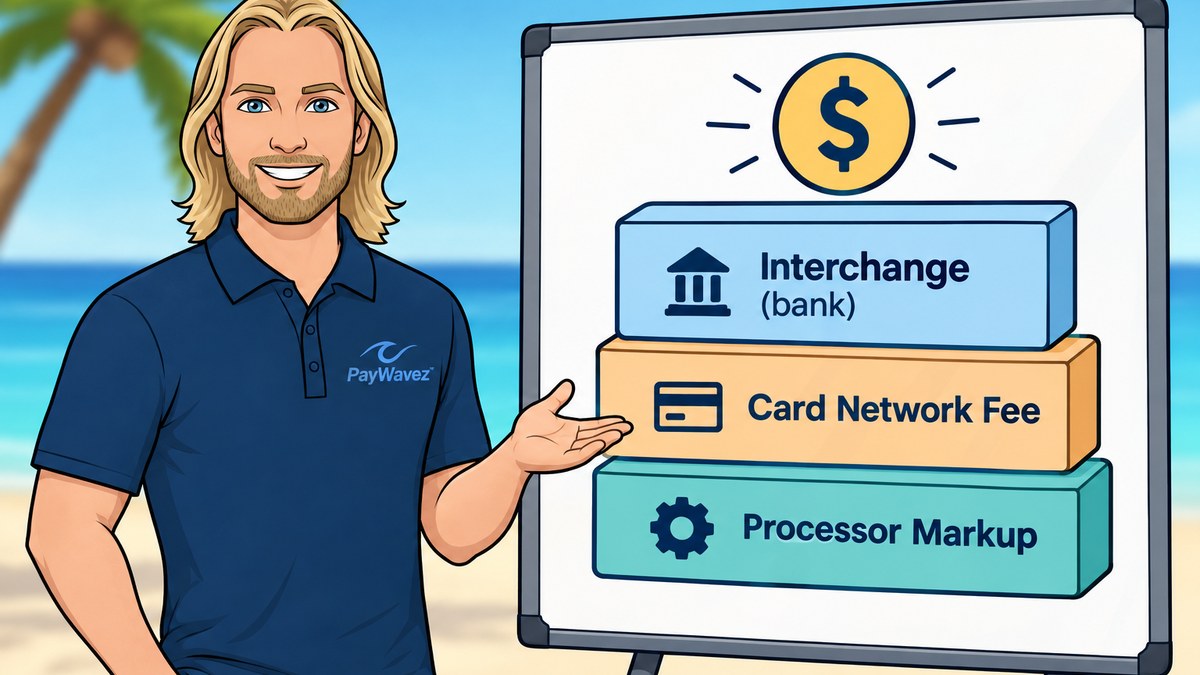
Every time a customer swipes, dips, or taps a card, the fee you pay is actually split three ways. You cannot negotiate the first two, but the third one is where you have some control.
- Interchange Fees: This is the largest portion. It goes to the bank that issued the customer's card (like Chase or Wells Fargo). These rates are set by Visa and Mastercard and are based on risk and reward levels.
- Assessment Fees: This small slice goes directly to the card brands (Visa, Mastercard, Discover, Amex) for the use of their network.
- Processor Markup: This is what your merchant services company charges to handle the transaction, provide support, and give you the equipment. This is the only part of the fee that is truly negotiable.
Key Insight: On average, interchange fees make up about 70% to 90% of the total cost of a transaction. The remaining 10% to 30% is where your processor makes their profit.
7 Hidden Fees to Look for on Your Statement
While interchange is standard, some processors add "junk fees" that provide little to no value. If you see these on your statement, it might be time to ask questions.
1. PCI Non-Compliance Fees
If you haven't completed your annual security questionnaire, your processor might charge you $20 to $100 per month. This is a penalty, not a service fee. Completing your compliance docs should stop this charge immediately.
2. Statement or Program Fees
Some companies charge $10 to $25 just to send you a PDF or paper statement. In the digital age, this is often an unnecessary markup.
3. Batch Header Fees
Every time you "close out" your terminal at the end of the day, you might be charged a small fee (usually $0.10 to $0.25). While small, it adds up over 30 days.
4. Minimum Processing Fees
If your business doesn't process enough volume in a month, the processor might charge a "monthly minimum" to make up the difference. This hits seasonal businesses the hardest.
"The most expensive fee is the one you didn't know you were paying. Transparency in your merchant statement is the only way to ensure your margins stay healthy."
5. IRS Reporting Fees
Processors are required to report your gross sales to the IRS via Form 1099-K. Some charge you an annual or monthly fee just for the "service" of filing this required paperwork.
6. Next-Day Funding Fees
Getting your money faster is great, but some processors charge an extra percentage or a flat monthly fee for the privilege. At PayWavez, we believe you should get your money quickly without being nickel-and-dimed.
7. Excessive Per-Transaction Fees
Beyond the percentage, you usually pay a flat cents-per-transaction fee. If this is higher than $0.10 or $0.15 on an Interchange Plus plan, you might be overpaying.
How to Calculate Your True Cost
Don't just look at the "rate" your salesperson promised you. Look at your Effective Rate. You can find this by taking your total fees for the month and dividing them by your total sales volume. For example, if you processed $10,000 and paid $300 in total fees, your effective rate is 3%. To make this easier, you can use our Effective Rate Calculator to see how your current statement stacks up against industry averages.
If you are operating a business in the Southeast, such as a shop in Gulf Shores, your seasonal volume might make these fees fluctuate. Having a processor that understands the Alabama payment processing landscape can help you avoid traps like monthly minimums during the off-season.
Ready to see a better way? You can view a live demo of our transparent reporting and see exactly how we break down costs for our partners.
Conclusion
Understanding credit card transaction fees doesn't require a degree in finance, but it does require a bit of digging. By identifying the difference between unavoidable bank fees and negotiable processor markups, you can take control of your business's bottom line. Remember, if you find that your fees are eating too much of your revenue, you can always explore the legality and implementation of credit card processing fees charged to customers to offset those costs entirely.
Ready to see your own numbers?
Run your real card volume through the calculator or apply in about two minutes.