
Restaurant Operations
The Best Payment Setup for a High-Volume Drive-Thru Restaurant
A fast drive-thru depends on more than just the kitchen; your payment setup needs to handle cars quickly without causing a bottleneck at the window.

When you run a drive-thru, speed is your most important metric. Every second a car sits at the window is a second that the rest of the line is getting frustrated. To keep things moving, you need a payment setup that is flexible, fast, and easy for your staff to use. Before diving into the hardware, it is helpful to understand the broader landscape of best payment processors for restaurants to see how different features impact your bottom line.
The "Line-Busting" Strategy
The best setup for a busy drive-thru does not actually start at the window. It starts in the line. "Line-busting" involves sending employees out to the cars with handheld devices to take orders and payments before the customer ever reaches the speaker box or the window. This allows the kitchen to start cooking earlier and clears the payment hurdle before the car even arrives at the pickup point.
For this to work, you need a PayWavez Smart Terminal. These handheld devices connect via long-range Wi-Fi or LTE, allowing your team to process transactions anywhere on your property. When the payment is handled early, the window simply becomes a pickup point, which can cut your total service time in half.
Industry data shows that for every 10 seconds shaved off a drive-thru transaction, customer satisfaction scores can increase by up to 5%.
Must-Have Hardware for the Window
If you prefer to keep all payments at the window, your hardware needs to be built for speed and durability. Here is what a professional setup looks like:
- Contactless/NFC Readers: Customers want to tap their phones or cards. It is much faster than inserting a chip or swiping a magstripe.
- Customer-Facing Displays: A screen that shows the total and allows for quick tipping reduces back-and-forth talking.
- Weatherproof Casing: If your team is handing a terminal out the window, it will be exposed to rain, heat, and humidity.
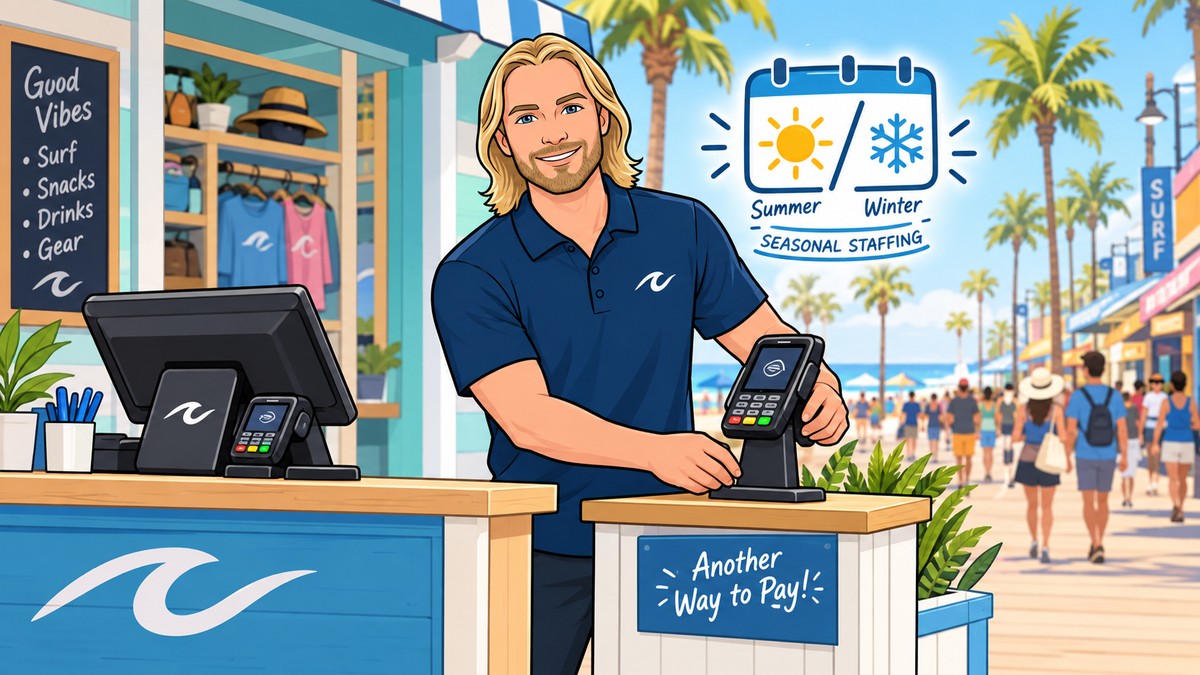
If you operate a beachside stand in Gulf Shores, you know that summer rushes require gear that won't fail in the heat or salt air. You can see how these systems work in real-time by viewing our live demo.
The window shouldn't be the first time your customer reaches for their wallet.
Lowering Costs with Dual Pricing
High-volume drive-thrus process hundreds of transactions a day. Those small processing fees add up to thousands of dollars every month. Many successful operators are moving to a dual pricing model. This setup shows a "card price" and a "cash price." Customers who choose to pay with a card cover the cost of the processing, which allows you to keep 100% of your menu price.
This is especially effective in Alabama, where business owners are looking for ways to offset rising labor and food costs. Check our Alabama payment processing hub for more regional insights on how local restaurants are using these programs to stay profitable.
Integration with Your Kitchen
A payment setup is only as good as its connection to your Kitchen Display System (KDS). When a payment is processed on a handheld terminal in the line, that order should instantly pop up on the kitchen screens. If your payment system and your POS (Point of Sale) don't talk to each other, you will end up with manual entry errors and slow service. Make sure your processor offers full integration so that sales data, inventory, and labor are all tracked in one place.
In summary, the best drive-thru setup combines handheld smart terminals for line-busting, fast NFC readers at the window, and a dual pricing program to protect your margins. For a deeper look at which companies provide these specific tools, revisit our guide on the best payment processors for restaurants.
Ready to see your own numbers?
Run your real card volume through the calculator or apply in about two minutes.