
Fees & Rates
What Is the Average Merchant Fee for Credit Cards?
For most small businesses, the average merchant fee for credit cards ranges between 1.5% and 3.5% per transaction. The exact amount you pay depends on your industry, the type of cards your customers use, and how you choose to process them.

When you look at your monthly merchant statement, the numbers can feel like a maze. Between interchange fees, assessments, and processor markups, it is hard to tell if you are getting a fair deal or being overcharged. Understanding the average merchant fee for credit cards is the first step toward taking control of your business expenses.
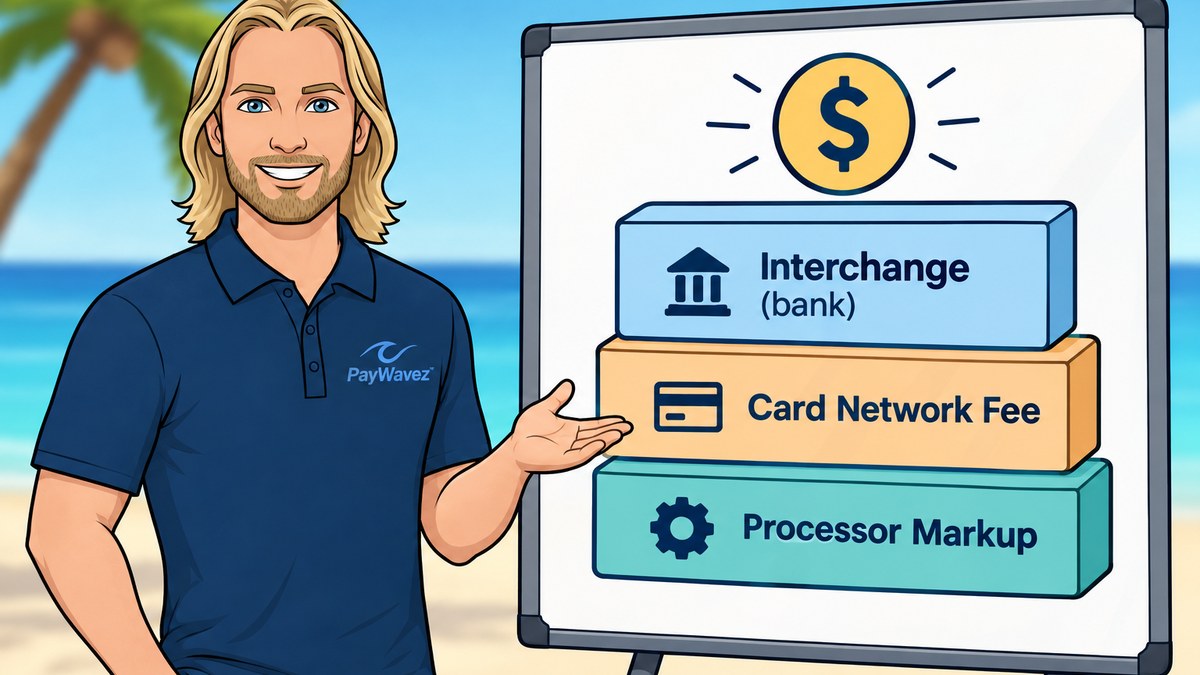
The Three Parts of Your Processing Fee
Merchant fees are not a single charge. They are actually a combination of three different costs that are bundled together by your provider. To understand the average, you have to look at what makes up the total.
- Interchange Fees: This is the largest portion of the fee. It is paid directly to the bank that issued the customer's card (like Chase or Wells Fargo). These rates are set by Visa and Mastercard and are the same for every processor.
- Assessment Fees: These are small fees paid directly to the card networks (Visa, Mastercard, Discover) for the use of their systems.
- Processor Markup: This is the only part of the fee that you can negotiate. It is what your merchant services provider charges to handle the transaction, provide support, and give you equipment like a PayWavez Smart Terminal.
On average, card-present transactions (swiped or dipped) cost between 1.5% and 2.5%, while card-not-present transactions (online or over the phone) average between 2.8% and 3.5% due to higher fraud risk.
Why Some Rates Are Higher Than Others
Not all credit cards are created equal in the eyes of the networks. A basic debit card has a very low interchange rate, often under 1%. However, a high-end rewards card or a corporate card can have an interchange rate of 2.5% or higher before the processor even adds their markup. This is why businesses that see a lot of premium travel cards often have a higher average merchant fee than a local coffee shop.
Pricing Models: Flat Rate vs. Interchange-Plus
How you are billed also changes your average cost. Some providers use flat-rate pricing, where you pay one set percentage (like 2.9% + $0.30) regardless of the card type. This is simple to understand but often more expensive for the merchant. Other providers use interchange-plus pricing, which passes the raw cost of the card through to you with a small, transparent markup. This is generally the most cost-effective way for growing businesses to manage fees.
Transparency in your merchant statement is the difference between a partner that helps you grow and a vendor that drains your profits.
How to Lower Your Average Merchant Fee
Many business owners assume they are stuck with the rates they were given when they first signed up. In reality, there are several ways to lower your average merchant fee for credit cards. One of the most effective methods is implementing a dual-pricing or surcharge program, which allows you to pass the processing cost to the customer while offering a discount for cash payments.
If you want to see exactly how these costs are calculated on your own transactions, you can check out our live demo to see the data behind every swipe. For businesses in the Southeast, having a local partner can also help. We provide hands-on support for merchants from our Alabama locations hub, including specific expertise for businesses in Gulf Shores that deal with seasonal tourism shifts.
Ready to see your own numbers?
Run your real card volume through the calculator or apply in about two minutes.