

Pricing
Interchange fees explained: what actually drives your processing cost
“Processing rate” is really three separate costs stacked together. Here's what each one is, who sets it, and which part your processor actually controls.

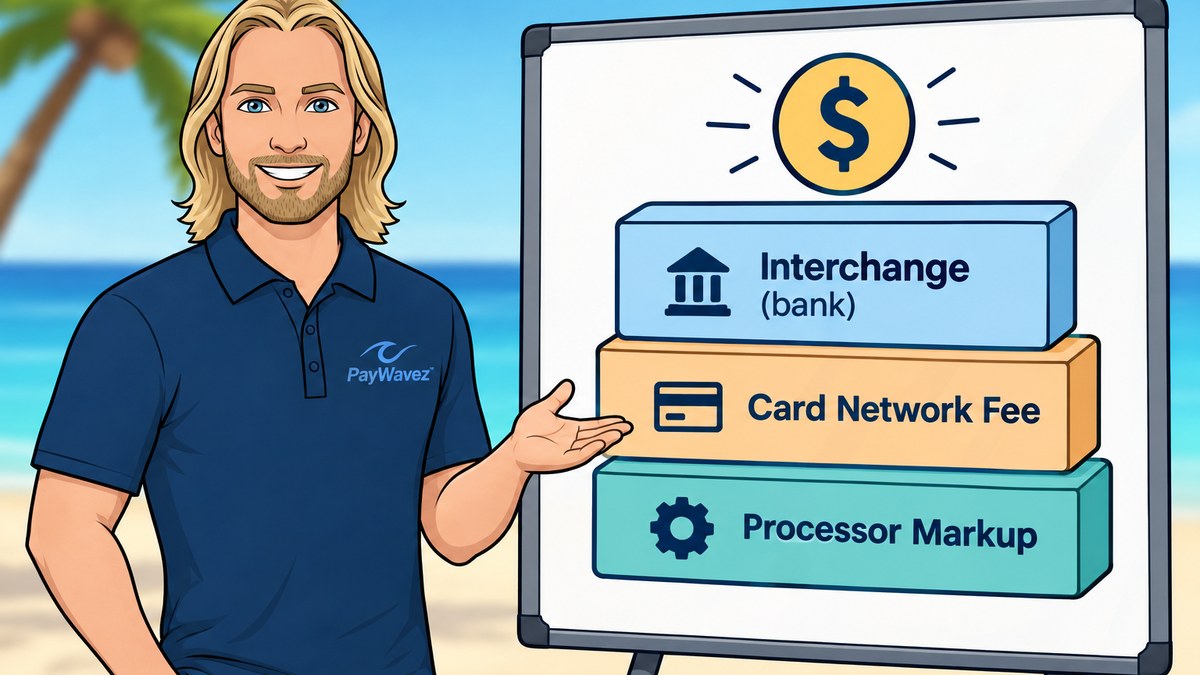
Every time a customer taps, dips, or swipes a card, the total cost a merchant pays isn't one number set by one company. It's three separate pieces stacked on top of each other, and understanding which piece is which is the fastest way to tell whether a quote is actually competitive.
The three layers of every card transaction
Interchange
Set by the card-issuing bank (Chase, Bank of America, etc.) and published by the card networks. This is the largest piece and it's non-negotiable — every processor pays the same interchange rate for the same card type and transaction.
Assessments
A smaller fee charged directly by Visa, Mastercard, Discover, or Amex for the use of their network. Also fixed and identical across processors.
Processor markup
The only layer that actually varies between providers — the margin a processor adds on top of interchange and assessments to cover its own service, support, and equipment.
Why interchange itself changes transaction to transaction
Interchange isn't a single flat number — the card networks publish dozens of interchange categories that vary by card type (standard rewards card vs. premium travel-rewards card vs. corporate card), how the card was accepted (chip/tap vs. keyed-in vs. card-not-present online), and the merchant's industry classification. A premium rewards card typically carries a higher interchange rate than a basic debit card, which is part of why an average blended rate can shift month to month even if a merchant's own processor markup never changes.
Why this matters when comparing processors
Because interchange and assessments are identical no matter who you process with, the only place processors can actually differentiate on cost is the markup layer — and the only place they can differentiate on how that markup is packaged is pricing model (flat-rate blended pricing, interchange-plus, tiered pricing, or a surcharge/dual-pricing program that shifts card cost to the paying customer instead of the merchant). A lower "rate" quote sometimes means a wider markup is hidden in a bundled tier rather than shown as a transparent add-on over true interchange cost. Reading a statement that breaks out interchange-plus-markup separately, rather than one blended number, is the most reliable way to see what you're actually paying for the processor's service versus what's simply passed through from the card networks.
Interchange-plus vs. flat-rate vs. tiered: how each hides or shows the markup
The pricing model a processor offers determines how visible that markup layer actually is. Interchange-plus pricing shows interchange and assessments as a pass-through line, with the processor's markup listed separately as its own clearly defined percentage and/or per-transaction fee — it's the most transparent structure because you can see exactly what the processor keeps. Flat-rate pricing blends everything into one number regardless of card type, which is simple to understand but means the processor is effectively averaging across all the interchange categories in your transaction mix — you pay the same rate on a low-interchange debit tap as a high-interchange rewards card, so the processor's actual margin varies transaction to transaction even though your rate doesn't. Tiered pricing sorts transactions into buckets like "qualified" and "non-qualified," each carrying a different blended rate, and the processor has real discretion over which transactions land in the pricier tiers — which is why tiered statements are usually the hardest to audit from the merchant's side.
What this means for your business
You can't negotiate interchange — nobody can. What you can evaluate is whether a processor's markup and pricing structure are disclosed clearly, whether a dual-pricing or surcharge program might offset most or all of your card cost, and whether hidden add-ons (monthly minimums, PCI non-compliance fees, batch fees) are quietly inflating your effective rate beyond the quoted number. PayWavez prices with that transparency in mind — quoting the markup layer directly rather than folding it into an opaque blended tier.
Ready to see your own numbers?
Run your real card volume through the calculator or apply in about two minutes.
Can a processor lower interchange fees for me?
No. Interchange is set by the card-issuing banks and published by the card networks (Visa, Mastercard, Discover, Amex). Every processor pays the same interchange rate for the same card type and transaction — it isn't something any processor can discount.
So what part of my rate can actually change between processors?
The markup layer — the margin a processor adds on top of interchange and network assessments. Pricing model (flat-rate, interchange-plus, tiered, or a surcharge/dual-pricing program) determines how that markup is packaged and how visible it is on your statement.
Why does my blended rate change from month to month even with the same processor?
Your transaction mix changes. A month with more premium rewards cards or more keyed-in/card-not-present transactions will carry higher interchange than a month dominated by basic debit taps, even though your processor's own markup hasn't moved.
What's the easiest way to see what I'm really paying my processor?
Ask for a statement or pricing structure that separates interchange-plus-assessments from processor markup, rather than one blended “rate.” That separation is the only way to compare the one number processors actually control.