
Fees & Taxes
Are Credit Card Processing Fees Subject to Sales Tax?
Understanding the tax implications of payment processing is vital for staying compliant and keeping your books clean. We break down when taxes apply and when they don't.

Are credit card processing fees subject to sales tax? This is a question we hear from small business owners every week as they look at their monthly statements and their tax filings. When you run a business, every penny counts, and taxes can be the most confusing part of your overhead. The answer depends entirely on which side of the transaction you are looking at. There are the fees your processor charges you, and then there are the fees you might charge your customers to cover those costs. Both have very different rules when it comes to the IRS and your state's Department of Revenue.
The Two Sides of Card Processing Fees
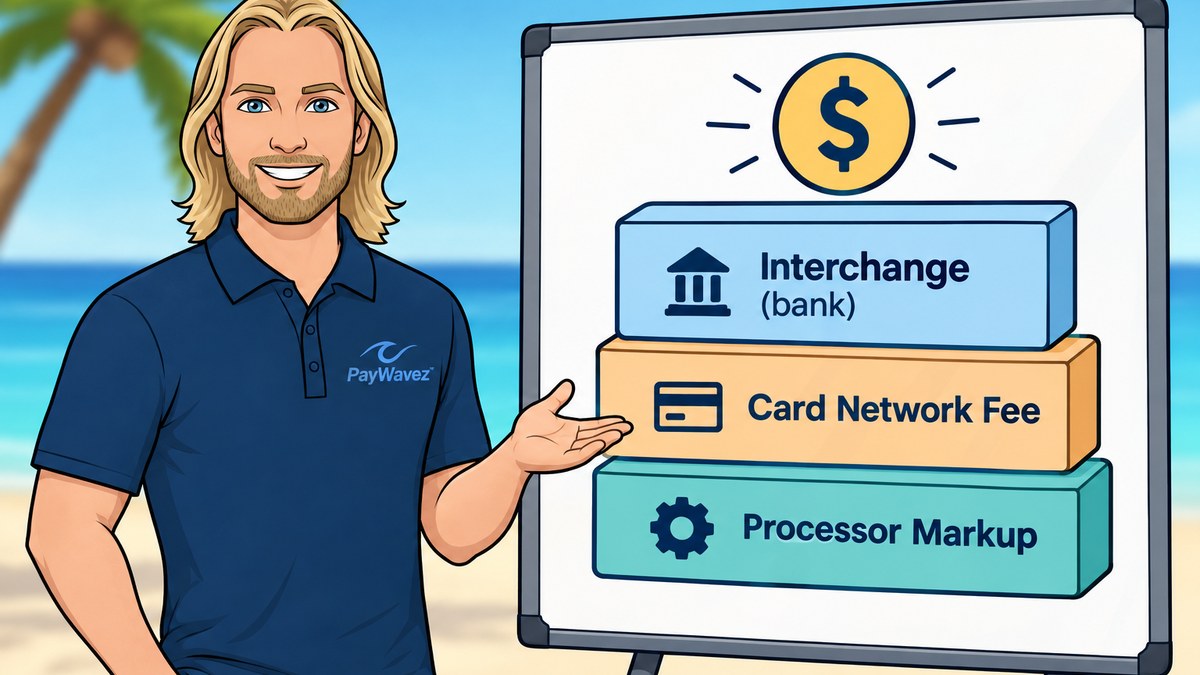
To understand if you owe tax, you first have to separate your merchant account into two categories. The first category is the backend fees. These are the charges you pay to PayWavez or any other merchant service provider to handle your transactions. This includes interchange fees, network fees, and the processor's markup. In the vast majority of states, these are considered professional services. Just like you usually don't pay sales tax on a lawyer's fee or an accountant's time, you generally do not pay sales tax on the service of moving money. These are business expenses that you can often deduct from your income tax, but they do not have a sales tax line item on your statement.
The second category is the frontend fees. This is where you, the merchant, decide to pass the cost of processing onto your customers through surcharging or a dual-pricing program. This is where the tax question gets much more complicated. If you add a 3% fee to a customer's bill to cover the credit card cost, the state might see that 3% as part of the total sales price. If the item you sold is taxable, that extra fee might be taxable too. It is vital to understand this distinction so you don't end up with a surprise bill during an audit.
Are credit card processing fees subject to sales tax?
In most United States jurisdictions, the fees paid by a merchant to a payment processor are exempt from sales tax because they are classified as non-taxable services. However, if you are asking if the surcharge you add to a customer's ticket is taxable, the answer is usually yes. Most state tax laws define the "sales price" as the total amount of money or value for which personal property or services are sold. This total price includes any charges by the seller to the buyer that are necessary to complete the sale.
Key Takeaway: Most states consider a credit card surcharge to be part of the "gross receipts" of a sale. If the product being sold is taxable, the fee added to cover the card processing cost is also taxable at the same rate.
For example, if you sell a piece of equipment for $100 in a state with a 7% sales tax, the tax is $7.00. If you add a 3% credit card surcharge ($3.00), many states require you to calculate the 7% sales tax on the new total of $103.00. This brings the total tax to $7.21. If you only charge tax on the original $100, you are under-collecting tax by 21 cents. While that sounds small, if you do that thousands of times a year, you could owe the state thousands of dollars in back taxes plus penalties. This is why having a modern POS system that handles these calculations automatically is so important for your business.
Surcharging vs. Cash Discounts: The Tax Difference
Many business owners choose between surcharging and cash discounting to offset their costs. From a tax perspective, these are handled differently. A surcharge is an addition to the price. As we discussed, an addition to the price is usually taxable. A cash discount, however, is a reduction in the price for customers who pay with green paper money. Since sales tax is calculated on the final price paid, a cash discount naturally lowers the tax amount for the customer. This makes cash discounting a bit simpler for bookkeeping. You simply tax the amount the customer actually pays.
Tax compliance isn't just about what you sell; it's about how you account for every penny added to the ticket.
With dual pricing, you present two different prices to the customer: one for card and one for cash. In this scenario, the sales tax is applied to whichever price the customer chooses. This is often the cleanest way to handle things because the tax is always a percentage of the displayed price. Whether you are using a live demo of our software or a standard terminal, you must ensure your tax settings are aligned with your pricing model.
Taxability of POS Terminals and Software
While the act of processing a payment is a service, the equipment you use is a tangible good. If you buy a credit card terminal, a tablet, or a full POS system, you will almost certainly pay sales tax on that purchase. This is true whether you buy it outright or lease it. In some states, even the monthly software subscription fee for your POS system is subject to sales tax. This is often called a "SaaS tax" (Software as a Service). States like Texas and New York have specific rules about taxing software that is accessed remotely.
If you are a business owner looking for Alabama payment processing, you should know that Alabama generally taxes the rental or lease of tangible personal property. This means if your merchant provider is charging you a monthly rental fee for a terminal, you might see a small sales tax charge on that specific line item. It is important to look closely at your statement to see which parts are being taxed and which are not. If you see tax being applied to your actual transaction volume fees, you should call your processor immediately, as that is likely an error.
State-Specific Considerations for Merchants
Every state has its own Department of Revenue, and they don't all agree. Some states are very aggressive about what they consider "gross receipts." For instance, if you operate in Gulf Shores credit card processing circles, you are dealing with both state and local beach taxes. You must ensure that any fee you add—whether you call it a convenience fee, a surcharge, or a service fee—is properly categorized in your POS system so the local tax rates are applied correctly.
Some states have even issued specific memos on this topic. They argue that because the merchant is the one responsible for the processing fee, any attempt to recover that fee from the customer is simply part of the overhead of the business, just like rent or electricity. Since you don't subtract your rent from the price before calculating sales tax, you shouldn't subtract the credit card fee either. Always check with a local tax professional or your state's revenue website to get the most current ruling for your specific zip code.
How to Configure Your POS System for Tax Accuracy
The best way to avoid a tax nightmare is to let technology do the heavy lifting. Modern POS systems, like those offered by PayWavez, allow you to set up tax rules that apply to specific fee types. When you set up a surcharge, you can usually toggle a setting that says "Taxable." If you turn this on, the system will automatically add the fee first, then calculate the sales tax on the new subtotal. This ensures that your records match what the state expects to see.
If you are using an older "dumb" terminal that doesn't talk to your cash register, you have to be much more careful. You might be manually adding a 3% fee on the terminal after the sale is already rung up on the register. If you do this, you are likely missing the tax on that 3%. This is a common way that small businesses get into trouble during audits. Moving to an integrated system where the terminal and the register are one and the same is the best way to stay compliant.
Common Merchant Tax Mistakes to Avoid
One of the biggest mistakes is assuming that because the fee is "reimbursement" for a cost you pay, it isn't income. The state doesn't care why you are charging the extra money; they only care that the money changed hands as part of a sale. Another mistake is failing to keep separate records for taxable and non-taxable sales. If you sell a mix of taxable goods (like clothes) and non-taxable services (like tailoring), and you apply a flat surcharge to the whole bill, you need to know how much of that surcharge applies to the taxable portion.
Finally, never assume your processor is handling your sales tax for you. Merchant service providers handle the movement of money between banks, but they do not typically file your state sales tax returns. That responsibility falls squarely on the business owner. Make sure you are pulling regular reports from your POS system that show exactly how much tax was collected on both your products and any additional fees you charged.
Ready to see your own numbers?
Run your real card volume through the calculator or apply in about two minutes.