
Fees & Rates
What is a POS Fee? A Merchant’s Guide to Understanding Card Costs
If you have ever looked at your monthly merchant statement and felt confused by the long list of charges, you are not alone. Understanding exactly what you are paying for is the first step to lowering your costs and increasing your profit.

What is a pos fee is a question many small business owners ask when they see a deduction from their bank account that they did not expect. In simple terms, a POS (Point of Sale) fee is the cost a business owner pays to accept credit and debit card payments through their checkout system. These fees are not just one single charge; they are usually a mix of several different costs bundled together. When you swipe, dip, or tap a customer’s card, a complex network of banks and technology providers works behind the scenes to move money from the customer to you. Each of those players wants a small piece of the transaction.
Breaking Down the Components of a POS Fee
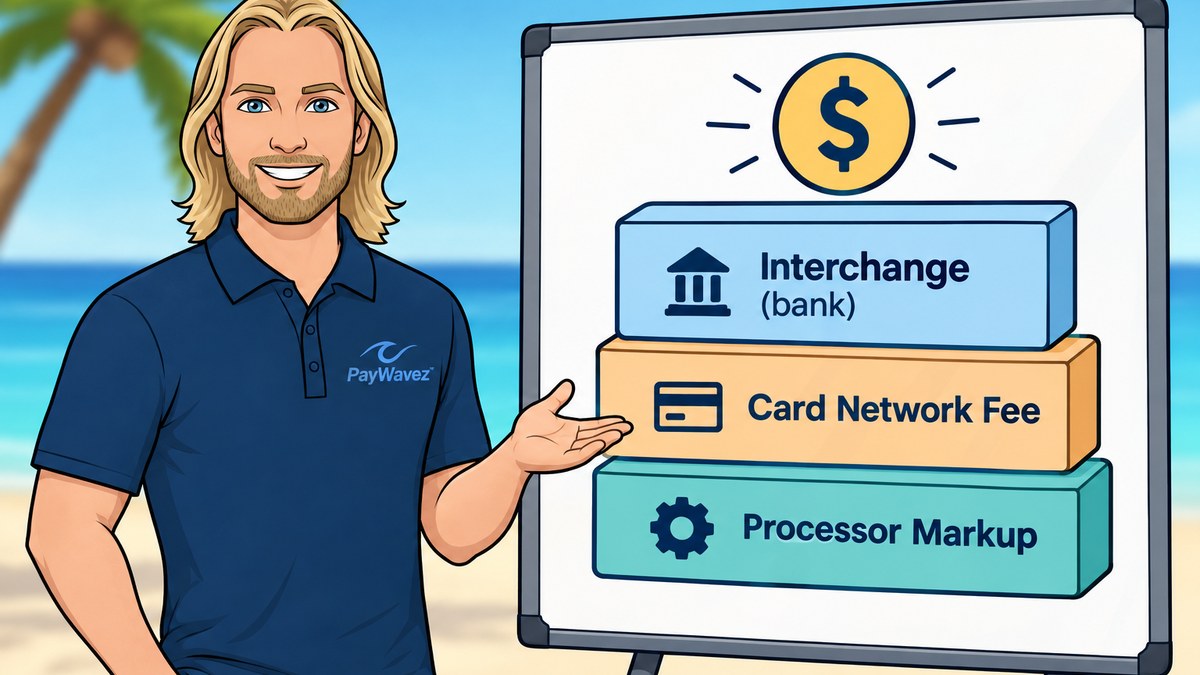
To understand your total cost, you have to look at the three main parts of a transaction fee. The first part is the interchange fee. This is the largest portion of the cost and goes directly to the bank that issued the customer’s card (like Chase or Wells Fargo). The second part is the assessment fee, which goes to the card brands like Visa, Mastercard, and Discover. These two costs are non-negotiable for every merchant in the United States.
The third part is the processor markup. This is where your merchant services provider makes their money. This is also the only part of the fee that is actually negotiable. Some processors charge a flat rate, while others use a model called interchange-plus. If you are a high-volume business, interchange-plus is usually much cheaper because it shows you exactly what the raw costs are versus what the processor is adding on top. If you want to see how these fees look in action, you can view a live demo of a transparent system.
According to industry data, the average small business pays between 2.5% and 3.5% in total processing fees per transaction, but hidden fees can often push this effective rate much higher.
What is a pos fee vs. a processing rate?
Many people use these terms interchangeably, but they can mean different things depending on your contract. A "processing rate" usually refers to the percentage you pay on every sale (like 2.9%). A "POS fee," however, often refers to the fixed costs associated with the physical or digital system you use to take the payment. This might include a monthly software subscription fee, a per-transaction fee (like $0.10 per swipe), or even a fee for the cellular data used by a mobile terminal.
For example, if you run a boutique in Destin, you might pay a 2.5% processing rate plus a $0.15 POS transaction fee. If you sell a $10 item, that $0.15 fee represents a much larger percentage of your sale than if you sold a $100 item. This is why it is vital for business owners to understand the difference between percentage-based costs and flat-fee costs.
Hardware vs. Software POS Fees
When you sign up with a merchant provider, you have to consider the cost of the equipment. Some companies will give you a "free" terminal, but they often make up for it by charging higher monthly software fees or locking you into a long-term contract with high rates. Other companies allow you to buy your hardware upfront. While this costs more today, it usually saves you money over the next three years.
Software fees are another common part of the POS cost structure. Modern POS systems do more than just take money; they track inventory, manage employee schedules, and run loyalty programs. You might pay a monthly fee per station or per location to access these features. It is important to audit these features regularly. If you are paying for an advanced inventory module but only use the system to ring up simple sales, you are throwing money away every month.
The most expensive fee a business owner pays is the one they do not understand. Transparency in your merchant statement is the key to long-term profitability.
Hidden POS Fees to Watch Out For
Not all fees are listed clearly on the front page of your statement. Some processors use "tiered pricing," which hides the true cost of transactions by grouping them into categories like "qualified," "mid-qualified," and "non-qualified." This is often a trap for small businesses because almost all modern cards (like rewards cards or business cards) fall into the most expensive "non-qualified" category.
Other hidden costs include:
- PCI Compliance Fees: A fee charged to ensure your business is following security standards. Some processors charge this monthly, while others charge a large annual fee if you don't complete your security profile.
- Statement Fees: A flat monthly charge just for the processor to send you a bill.
- Batch Header Fees: A small fee charged every time you "close out" your terminal at the end of the day.
- Minimum Processing Fees: If you don't process a certain dollar amount in a month, the processor may charge you a penalty fee to make up the difference.
How Surcharging and Dual Pricing Can Offset POS Fees
One of the most effective ways for US small business owners to deal with the rising cost of card payments is through surcharging or dual pricing programs. In a surcharging program, the POS system automatically adds a small percentage (usually around 3% to 4%) to the customer's bill if they choose to pay with a credit card. This covers the processing cost so the business owner keeps 100% of the sale price.
Dual pricing is a slightly different approach where the merchant lists two prices for every item: a cash price and a card price. This is becoming very popular across the Alabama payment processing landscape because it is easy for customers to understand and fully compliant with all card brand rules. By using these programs, many businesses are able to reduce their processing costs to nearly zero dollars per month.
Tips for Negotiating Your Merchant Account Fees
You do not have to accept the first rate a processor offers you. Merchant services is a highly competitive industry, and you have leverage. Before you call to negotiate, make sure you have your last three months of statements ready. Look for your "effective rate," which is your total fees divided by your total sales volume. If that number is over 3.5%, you are likely overpaying.
Ask your processor to move you to an interchange-plus pricing model. This is the gold standard for transparency. You should also ask them to waive the statement fees and the PCI non-compliance fees (provided you are actually compliant). If they refuse to budge, it might be time to look for a new partner who values your business.
Ready to see your own numbers?
Run your real card volume through the calculator or apply in about two minutes.