
Rates & Fees
Interchange Fees vs. Processing Fees: What is the Difference?
Many business owners treat their credit card bill as one giant expense, but that total is actually split between the banks and your merchant provider. Knowing who gets what is the key to negotiating a better deal.

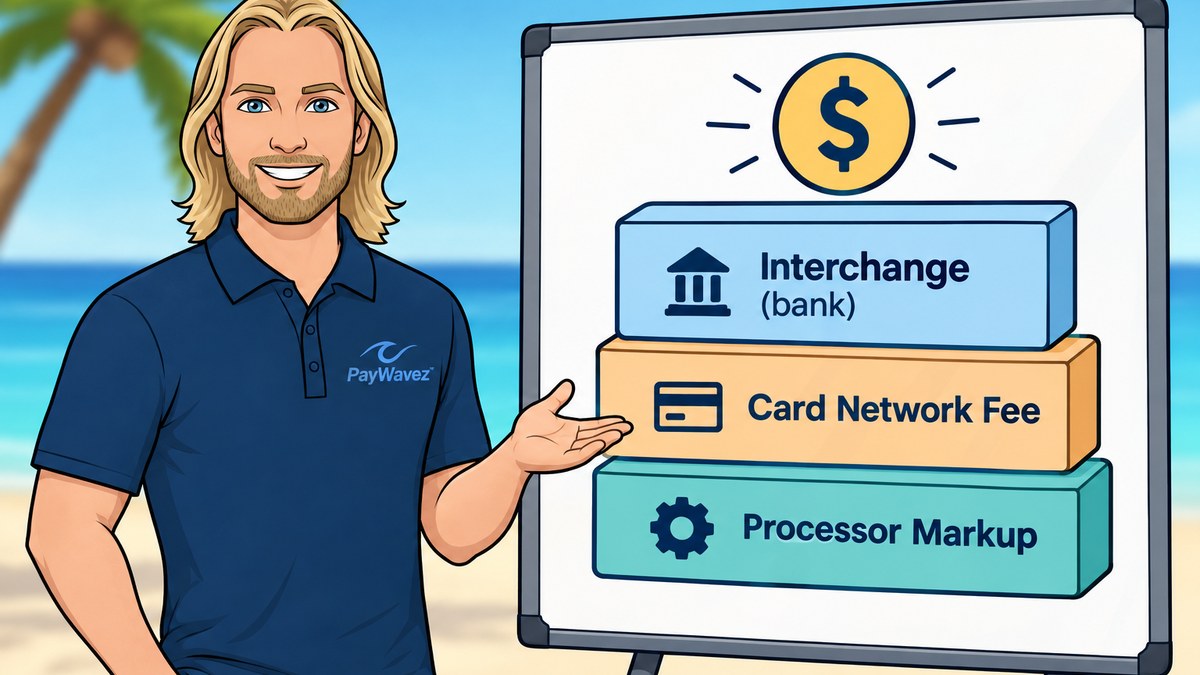
When you look at your monthly merchant statement, you might see a long list of confusing numbers. Most of those costs fall into two buckets: interchange fees and processing fees. To understand your bill, think of it like a grocery store. There is the wholesale price the store pays for the milk (interchange), and then there is the markup the store adds to keep the lights on (processing).
What are Interchange Fees?
Interchange fees are the "wholesale" cost of a credit card transaction. Every time a customer swipes a card, your business has to pay a small fee to the bank that issued that card (like Chase, Wells Fargo, or Bank of America). These fees are set by the card networks—Visa, Mastercard, Discover, and American Express.
No matter which payment processor you use, the interchange fee remains the same. It is non-negotiable. The specific rate depends on several things, such as:
- The type of card: A basic debit card has lower fees than a high-end travel rewards card.
- How the card is processed: Swiping a card in person is cheaper than typing the numbers into a website.
- Your industry: A grocery store might have different rates than a luxury hotel.
Visa and Mastercard update their interchange rate tables twice a year, typically in April and October. There are currently over 300 different interchange levels based on card type and transaction risk.
What are Processing Fees?
Processing fees are the markup your payment provider charges for their service. This is how companies like Square, Clover, or PayWavez make money. This fee covers the cost of the technology, the customer support, and the risk of managing your account.
Unlike interchange, processing fees are negotiable. If you feel you are paying too much, this is the area where you have the most room to move. You can see how these fees look in action by viewing our live demo of a modern payment system.
Interchange is the cost of doing business with the banks; processing fees are the price you pay for your provider's service and technology.
The Third Piece: Assessment Fees
While most people focus on the big two, there is a tiny third piece called assessment fees. These are paid directly to the card brands (Visa/Mastercard) for using their network. Like interchange, these are non-negotiable and are usually very small (often less than 0.15%).
Why This Distinction Matters to Your Bottom Line
If you don't know the difference between these fees, you might not realize you are being overcharged. Some processors use "flat-rate" pricing, where they charge you one high percentage (like 2.9%) regardless of what the actual interchange cost was. Others use "Interchange-Plus" pricing, which passes the wholesale cost directly to you and adds a small, transparent markup.
For businesses in specific regions, like those using our Alabama payment processing services, choosing the right pricing model can save thousands of dollars a year. If you want to see exactly how much you could save by switching models, you can use our Processing Fee Calculator to compare your current rates against transparent ones.
How to Spot Them on Your Statement
Reading a merchant statement can be a headache. Look for a section labeled "Interchange Detail." This will show you exactly what the banks charged. Then, look for a section called "Service Fees" or "Processor Markup." If these two aren't clearly separated, you are likely on a bundled or tiered plan, which is often the most expensive way to process cards.
Ready to see your own numbers?
Run your real card volume through the calculator or apply in about two minutes.