
Fees & Rates
Everything You Need to Know About Interchange Fees for Credit Cards
Interchange fees are the largest part of your processing costs, but they don't have to be a mystery. We break down how these fees work and how you can keep more of your hard-earned revenue.

Understanding interchange fees for credit cards is the first step toward lowering your monthly merchant statement and taking control of your business finances. If you have ever looked at your monthly processing statement and felt confused by the long list of fees, you are not alone. Most of those costs come from a single source: interchange. These are the wholesale costs set by card networks like Visa and Mastercard. They are paid by the merchant's bank to the cardholder's bank to cover the costs of processing, fraud risk, and even those fancy reward points your customers love. Because these fees are the 'base cost' of every transaction, they dictate almost everything you pay as a business owner.
What Exactly Are Interchange Fees?
At its simplest level, an interchange fee is a small percentage of a transaction plus a flat fee (like $0.10) that is charged every time a customer swipes, dips, or taps a card. These fees are not kept by your payment processor. Instead, they are passed through to the bank that issued the customer's card. For example, if a customer uses a Chase Sapphire card at your shop, the interchange fee goes to Chase. This money helps banks handle the risk of lending money to consumers and pays for the infrastructure that makes instant payments possible. Whether you are operating a retail storefront in Alabama or a service business near the coast, these fees are a universal part of the modern economy.
The card networks (Visa, Mastercard, Discover, and American Express) publish these rates twice a year, usually in April and October. There are hundreds of different interchange categories, ranging from a basic debit card to a high-end business travel card. Because there are so many variables, it is hard for a merchant to know exactly what they will pay until the transaction actually happens. However, knowing the factors that drive these rates can help you make better decisions about which cards to encourage and how to set up your point-of-sale system.
Interchange fees typically account for 70% to 90% of the total fees a merchant pays to accept credit cards, making them the most important factor in your overall processing cost.
Why Interchange Fees for Credit Cards Are Non-Negotiable but Manageable
One of the biggest misconceptions in the payments industry is that you can negotiate your interchange rates. You cannot. These rates are set in stone by the card brands and are the same for every processor. Whether you are a tiny coffee shop or a massive big-box retailer, the 'wholesale' cost for a specific card type is identical. However, while you cannot change the rates themselves, you can change how you are charged for them and how you manage your transactions to ensure you get the lowest possible rate available for that card.
For instance, some processors use 'Tiered Pricing,' where they bucket different interchange rates into 'Qualified' and 'Non-Qualified' categories. This often results in the processor keeping a large chunk of the difference. A better alternative is Interchange Plus pricing, which passes the exact interchange cost to you with a small, transparent markup. This transparency is why we always recommend seeing a live demo of how transparent reporting looks before you sign a contract. By seeing the raw data, you can spot where you might be 'downgrading'—a process where a transaction costs more because it didn't meet certain security requirements.
Factors That Influence Your Interchange Rate
Not all transactions are created equal. Several factors determine which interchange category a sale falls into. The most common include:
- Card Type: Debit cards have the lowest fees because they carry the least risk. Premium rewards cards and business cards have the highest fees to fund those perks.
- Transaction Method: Swiping a card in person (Card-Present) is cheaper than taking a payment over the phone (Card-Not-Present) because the risk of fraud is lower when the customer is standing in front of you.
- Business Type: Card networks assign different rates based on your industry. A grocery store might have a different rate than a high-end jewelry shop in Pensacola.
- Data Provided: For business-to-business (B2B) sales, providing extra info like tax IDs or zip codes (Level 2 or Level 3 data) can significantly lower the interchange cost.
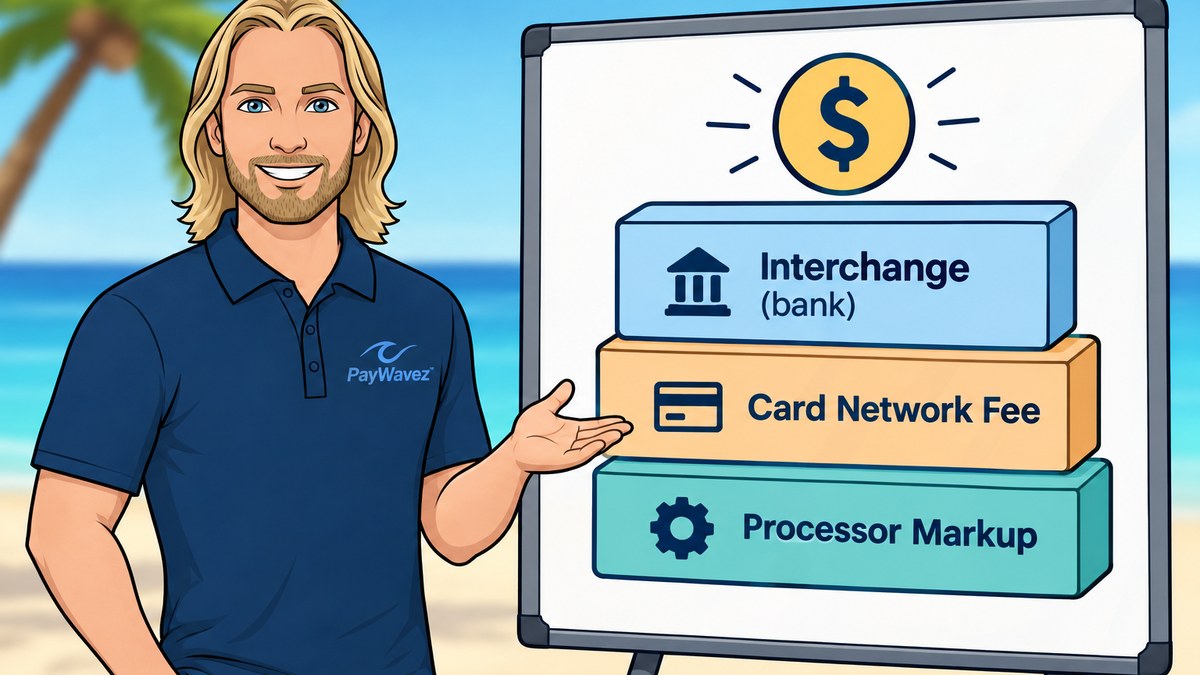
Interchange is the only part of your fee that goes directly to the bank that issued the card. Your processor only makes money on the small markup above this wholesale cost.
The Difference Between Interchange and Assessment Fees
While interchange goes to the issuing bank, assessment fees go to the card brands themselves (Visa, Mastercard, etc.). These are usually much smaller—often less than 0.15% of the transaction. Together, interchange and assessments make up the 'non-negotiable' part of your bill. Everything else on your statement is a processor fee. If your statement is cluttered with 'Admin Fees,' 'PCI Non-Compliance Fees,' or 'Statement Fees,' those are markups that you should look at closely. Understanding the difference helps you see exactly where your money is going and who is actually getting paid.
How to Lower Your Effective Rate
Even though the base rates are fixed, you can lower your 'effective rate' (the total percentage you pay after all fees are added up). One way is to ensure your staff always uses the most secure method available. If you have a chip reader, make sure you use it. If you manually type in a card number, you are likely paying a higher interchange rate because the bank views that as a higher risk. Another strategy is to look into 'Dual Pricing' or surcharging. These programs allow you to pass the cost of the interchange fees directly to the customer who chooses the convenience of a credit card, while offering a discount to those who pay with cash or debit. This can effectively bring your processing costs down to near zero.
For merchants on the Gulf Coast and across the country, staying educated on these shifts is vital. As technology changes, the card brands update their rules. Staying compliant with the latest security standards, like EMV and PCI DSS, isn't just about safety—it's about keeping your interchange fees in the lowest possible bracket. When you ignore these standards, your transactions 'downgrade,' and you end up paying the 'Non-Qualified' rate, which can be double what you should be paying.
Ready to see your own numbers?
Run your real card volume through the calculator or apply in about two minutes.