
Processing Costs
How to Avoid Debit Card Transaction Fees in Your Small Business
Stop letting swipe fees eat your profits. Discover the strategies and programs that help small business owners eliminate or drastically reduce debit card processing costs.

How to avoid debit card transaction fees is one of the most common questions we hear from small business owners who are tired of seeing their hard-earned revenue disappear into the pockets of big banks. Every time a customer swipes or taps a debit card, you are charged a fee. While these fees are often lower than credit card fees, they still add up to thousands of dollars every year. For a small business operating on thin margins, those thousands of dollars could be the difference between hiring a new employee or keeping the lights on.
Understanding the Basics of Debit Card Fees
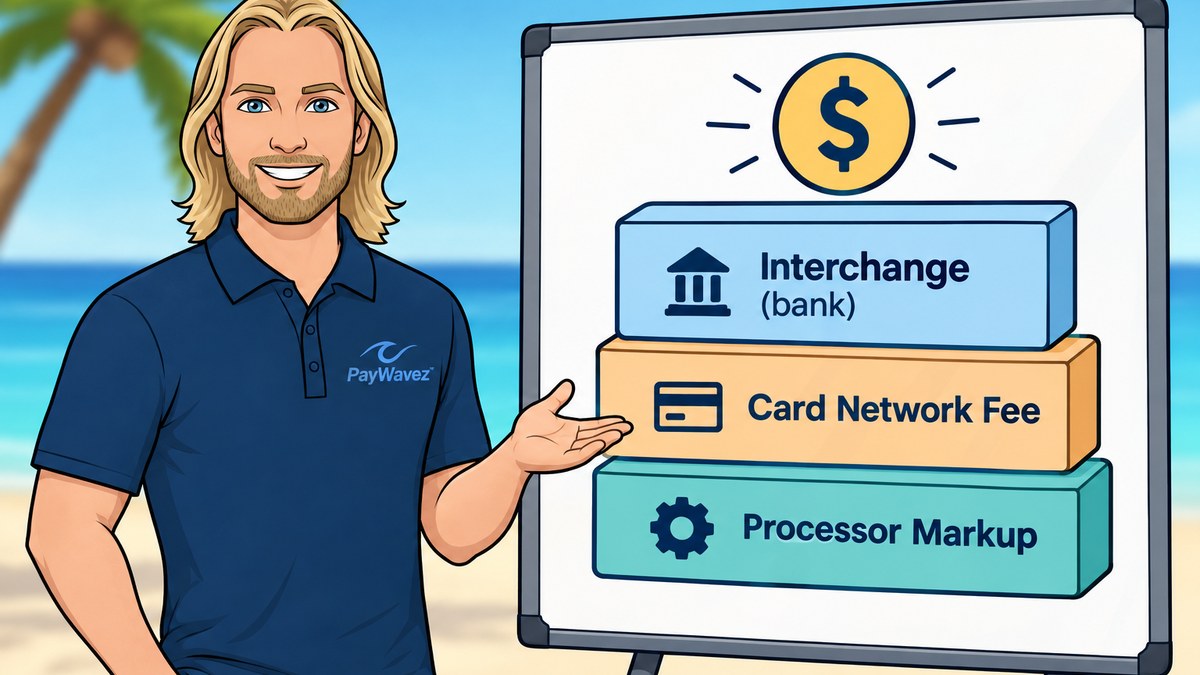
Before you can learn how to avoid these costs, you have to understand what they are. Debit card fees are generally made up of three parts: interchange fees, assessment fees, and processor markups. Interchange is the largest portion and goes to the bank that issued the card. Assessment fees go to the card brands like Visa or Mastercard. The processor markup is what your merchant services provider charges you for the service of handling the transaction.
In the United States, the Durbin Amendment was passed to help small businesses. It put a cap on how much large banks can charge for debit transactions. However, many processors do not pass these savings on to the merchant. Instead, they charge a flat rate that hides the true cost of the transaction. If you want to know how to avoid debit card transaction fees that are higher than they should be, you first need a statement that shows you exactly what you are paying for each swipe.
The Durbin Amendment caps debit interchange for large banks at 0.05% plus 22 cents per transaction. If you are paying a flat rate of 2.6% or higher on debit, you are likely overpaying by a significant margin.
The Most Effective Way How to Avoid Debit Card Transaction Fees Today
The single most powerful tool in your arsenal is a program called Dual Pricing. Unlike traditional surcharging, which only applies to credit cards, dual pricing allows you to set two prices for every item: a card price and a cash price. When a customer pays with a debit card, they pay the card price, which covers the cost of the transaction. When they pay with cash, they get a discount.
This is legally different from a surcharge. Because you are offering a discount for cash rather than a penalty for cards, it is allowed in all 50 states and applies to both credit and debit cards. This is the ultimate answer for how to avoid debit card transaction fees entirely. By passing the cost of the processing to the consumer in a transparent way, your business can reach a $0.00 processing bill at the end of the month. Many businesses in the South, from retail shops in Alabama to restaurants in Destin, are already using this to protect their profits.
The Difference Between Signature and PIN Debit
Another way to manage costs is to understand how the transaction is routed. When a customer uses a debit card, it can be processed as a "signature" debit or a "PIN" debit. Signature debit runs through the Visa or Mastercard networks. PIN debit runs through regional networks like Star, Pulse, or NYCE. Depending on your average ticket size, one may be significantly cheaper than the other.
Generally, for large transactions, PIN debit is cheaper because it often has a flat fee rather than a percentage. For very small transactions, signature debit might be cheaper. A smart merchant service provider will help you set up "Least Cost Routing." This technology automatically sends the transaction through the cheapest possible network for that specific sale. This is a technical but effective way to lower your overhead without changing how you interact with customers.
Every dollar you save on processing fees is a dollar that goes directly back into your business's growth and stability.
Switching to Interchange-Plus Pricing
Many small business owners start with a flat-rate processor because it is easy to understand. You pay 2.9% plus 30 cents for everything. However, this is usually the most expensive way to take payments. Debit cards have much lower base costs than premium credit cards. When you use a flat-rate processor, they keep the difference between the low debit cost and the high flat rate you pay.
To avoid these unnecessary costs, you should switch to Interchange-Plus pricing. With this model, your processor charges you the exact cost of the interchange (the base fee) plus a small, transparent markup. Because debit interchange is so low due to federal regulations, your total cost for a debit transaction on an Interchange-Plus plan is often less than 1%. This is a massive saving compared to the 2.6% or 3% you might be paying elsewhere.
Avoiding Monthly Junk Fees and Hidden Costs
Sometimes the fees aren't just on the swipes. Many merchant accounts are loaded with "junk fees" that have nothing to do with the actual transactions. These include statement fees, PCI non-compliance fees, minimum processing fees, and annual fees. If you look at your statement and see charges for things you don't understand, you are likely being overcharged.
How to avoid debit card transaction fees also means avoiding the fees that surround the account itself. A reputable processor will offer a month-to-month contract with no hidden fees. They will also help you stay PCI compliant so you don't get hit with those $20 to $40 monthly penalties. If your current provider won't waive these fees, it is probably time to look for a new partner who values transparency.
Upgrading Your POS Hardware
Your hardware also plays a role in your costs. Older terminals might not support the latest routing technologies or dual pricing programs. Modern smart terminals and Point of Sale (POS) systems are designed to help you save money. They can handle PIN debit properly, manage dual pricing automatically, and provide detailed reporting so you can see exactly where your money is going.
If you are still using a basic credit card terminal from ten years ago, you are likely missing out on features that could save you hundreds of dollars a month. You can see how modern systems work by checking out a live demo of current payment technology. Modern systems make it easy to implement the cost-saving strategies we've discussed here without slowing down your checkout line.
Negotiating with Your Current Processor
You don't always have to switch companies to save money, though it is often the fastest way. If you have been with the same processor for a long time, you can try to negotiate. Call them and ask for a lower markup. Tell them you are looking into Interchange-Plus pricing or a Dual Pricing program. Because the payments industry is very competitive, they may lower your rates to keep your business.
However, be careful. Some processors will lower one fee while raising another. This is why having a professional statement review is so important. You need to know the "effective rate," which is the total amount of fees divided by the total amount of sales. If your effective rate is over 3%, and you take a lot of debit cards, you are definitely overpaying.
Ready to see your own numbers?
Run your real card volume through the calculator or apply in about two minutes.