

Processing Costs
How payment processing rates are actually calculated
Your effective rate isn't one number set by your processor — it's several layers stacked on top of each other, and understanding the stack is what lets you evaluate a quote honestly.

When a processor quotes "2.6% + 10¢," that number isn't arbitrary — it's built from several distinct layers, most of which the processor doesn't actually control. Understanding the stack is the difference between comparing quotes accurately and comparing headline numbers that don't mean what they appear to mean.
Layer one: interchange
Interchange is the fee paid to the card-issuing bank on every transaction, set by the card networks (Visa, Mastercard, Discover, Amex) and published in public interchange tables. It varies by card type — a rewards or business card typically carries a higher interchange rate than a basic debit card — and by how the transaction was processed. No processor sets or profits from this layer; it passes through to the issuing bank.
Layer two: card network assessments
On top of interchange, the card networks themselves charge a small assessment fee for running the network infrastructure your transaction travels through. Like interchange, this is fixed by the network and identical regardless of which processor you use.
"Interchange and assessments are pass-through costs set by the card networks — the only layer any processor actually controls is their own markup."
Standard breakdown used across processing-cost education
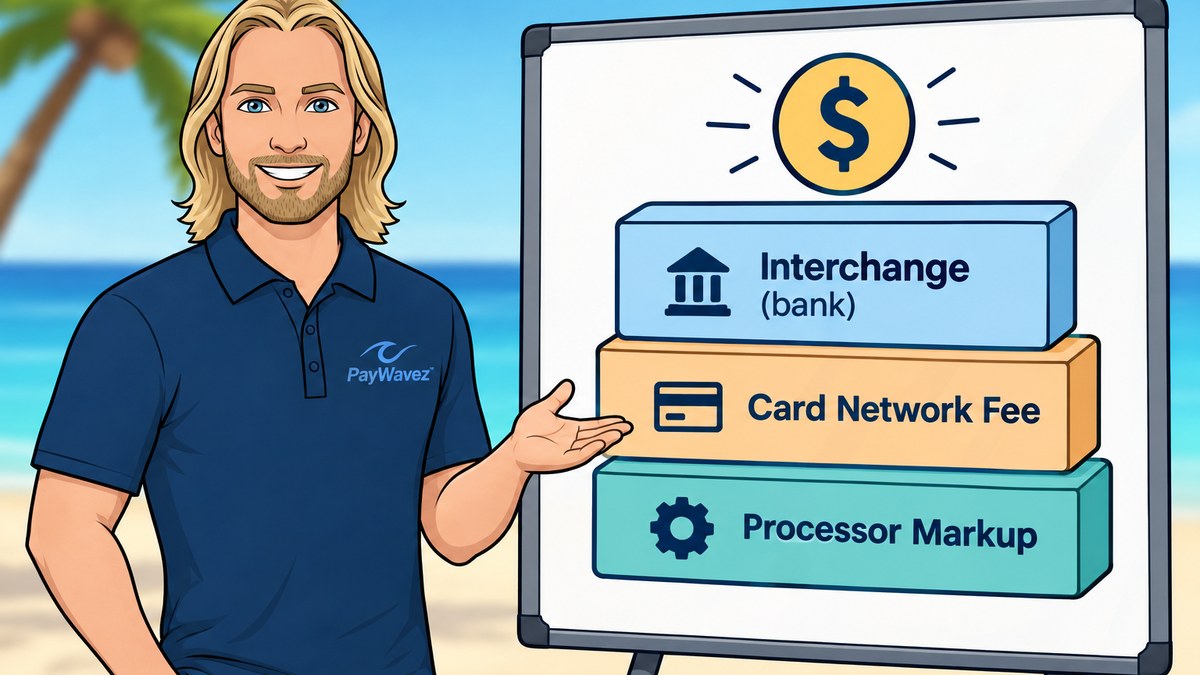
Layer three: processor markup
This is the layer a processor actually sets and profits from, and it's the only layer that's genuinely negotiable. It can be structured as a flat percentage added to interchange ("interchange-plus"), or bundled into a single "blended" rate that averages all your card types into one number regardless of the actual interchange cost of each transaction.
3
Layers in every processing rate: interchange, network assessment, processor markup
1
Layer that's actually negotiable — the processor's own markup
0
Control any processor has over interchange or network assessment pricing
See your own real rate breakdown
Run your actual card volume through the calculator to see where your money is going layer by layer.
Blended vs. interchange-plus pricing
Blended pricing quotes one flat rate across all card types, which is simpler to read but can quietly overcharge you on lower-cost transactions to subsidize higher-cost ones. Interchange-plus pricing shows the true interchange cost per transaction plus a fixed markup on top, which is more transparent but takes a bit more effort to read on a statement. Neither is universally right — but knowing which one you're being quoted changes how you should evaluate the number.
What to actually compare between quotes
The headline percentage alone doesn't tell you much. Compare the full fee schedule: per-transaction fees, monthly account fees, PCI compliance fees, batch fees, and any early-termination or equipment lease terms. A processor with a slightly higher headline rate but no monthly fees and no lease commitment can easily come out cheaper for a lower-volume business than one with an aggressive headline number and a stack of add-on fees.
What's the difference between interchange and my processor's rate?
Interchange is set by the card networks and paid to the card-issuing bank — no processor controls it. Your processor's rate is interchange plus a markup the processor adds on top for their own service.
Why does my rate change from transaction to transaction?
Interchange rates vary by card type (rewards cards cost more than basic debit), how the card was entered (tapped/chip vs. keyed), and your business's merchant category code. A blended rate averages this variation into one number; interchange-plus pricing shows it transaction by transaction.
Is a lower quoted rate always a better deal?
Not necessarily. A low headline rate can be paired with a high per-transaction fee, monthly fees, or a narrow definition of which transactions qualify for that rate. Compare the full fee schedule, not just the advertised percentage.
Can I negotiate my rate?
You can negotiate the processor's markup layer, since that's the portion the processor actually controls. Interchange and card network assessments are fixed regardless of which processor you use.
Ready to see your own numbers?
Run your real card volume through the calculator or apply in about two minutes.