
Fees & Rates
How Much Do Banks Charge Merchants for Credit Card Transactions?
Understanding the complex web of interchange, assessments, and markups is the only way to ensure your small business isn't leaking profit on every swipe.
How much do banks charge merchants for credit card transactions is the most critical question for any small business owner looking to protect their bottom line. When you swipe a customer's card, the money doesn't just travel from their account to yours; it passes through a gauntlet of financial institutions, each taking a small piece of the pie. Before we dive into the weeds, you might also want to check out our basic guide on how much are card processing fees for a quick overview of the general landscape.
Understanding the Three-Part Fee Structure
To understand the total cost of a transaction, you have to look at the three distinct entities that get paid every time a customer uses a credit card. First, there is the issuing bank (the bank that gave the customer their card). Second, there is the card network (Visa, Mastercard, Discover, or American Express). Third, there is your merchant service provider or payment processor. Each of these players has a different fee structure, and only one of them is truly negotiable for the merchant.
Most small business owners see a single percentage on their monthly statement and assume it all goes to the same place. In reality, that 2.5% or 3.0% fee is split. The lion's share actually goes to the issuing bank to cover the risk of lending money and to fund those flashy cash-back reward programs that consumers love. As a merchant, you are effectively subsidizing your customers' airline miles and hotel points.
How much do banks charge merchants for credit card transactions?
On average, the issuing bank charges an interchange fee that ranges from 1.15% plus $0.05 to over 3.0% for premium rewards cards. This is the non-negotiable "wholesale" cost of doing business. Banks justify these fees by pointing to the massive risk they take on. When a bank issues a credit card, they are essentially giving the consumer an unsecured loan. They also have to cover the costs of fraud prevention and the interest-free period between the purchase and the customer's payment due date.
The specific amount the bank charges depends heavily on the type of card presented. A basic debit card, regulated by the Durbin Amendment, might only cost you 0.05% plus $0.22. However, a high-end business rewards card or a "Signature" Visa card will always carry a much higher interchange rate. This is why your effective rate can fluctuate month to month even if your processor's markup stays the same. If more customers happen to use premium cards in December than in November, your costs will naturally rise.
The Difference Between Interchange and Assessment Fees
While the bank takes the interchange fee, the card networks (Visa and Mastercard) take what is known as an assessment fee. These are generally much smaller, usually hovering around 0.13% to 0.15% of the transaction volume. These fees pay for the operation of the global payment network, the branding, and the infrastructure that allows a card issued in New York to work seamlessly at a boutique in Destin, Florida.
Assessment fees are also non-negotiable. No matter which processor you use, whether it is a giant like Square or a specialized provider like PayWavez, these fees remain the same. They are set by the networks themselves and updated twice a year, usually in April and October. If you see your rates jump suddenly during those months, it is often due to a network-wide assessment increase rather than a change from your processor.

Why Your Merchant Account Provider Adds a Markup
The third piece of the puzzle is the processor markup. This is the only part of the fee that is actually negotiable. Your merchant service provider provides the hardware, the software, the customer support, and the security (PCI compliance) that allows you to interface with the banks and networks. For this service, they add a margin on top of the wholesale costs.
Processors use several different pricing models to charge this markup. The most common for very small businesses is flat-rate pricing, where you pay a fixed percentage regardless of the card type. While simple, this is often the most expensive option because the processor builds in a large cushion to cover the high-cost rewards cards. For growing businesses, interchange-plus pricing is almost always better, as it passes the wholesale cost directly to you with a transparent, fixed markup on top.
The most expensive merchant account isn't the one with the highest percentage; it's the one with the most hidden fees buried in the fine print. Transparency is the only way to truly save.
Pricing Models: Flat Rate vs. Interchange-Plus
If you are using a provider that charges a flat 2.6% + $0.10 for every transaction, you might feel like you have a handle on your costs. However, you are likely overpaying on every debit card transaction. Since debit cards have a wholesale cost of nearly zero, the flat-rate processor is pocketing a massive margin on those sales. By switching to an interchange-plus model, you pay the actual bank rate plus a small, agreed-upon fee.
At PayWavez, we advocate for transparency. We believe merchants should see exactly what the banks are charging and what we are charging. This allows you to audit your statements and understand where your money is going. If you want to see how these different models look in a real-world scenario, you can book a live demo of our reporting dashboard to see the breakdown of every transaction.
Using Surcharging and Cash Discounts to Offset Costs
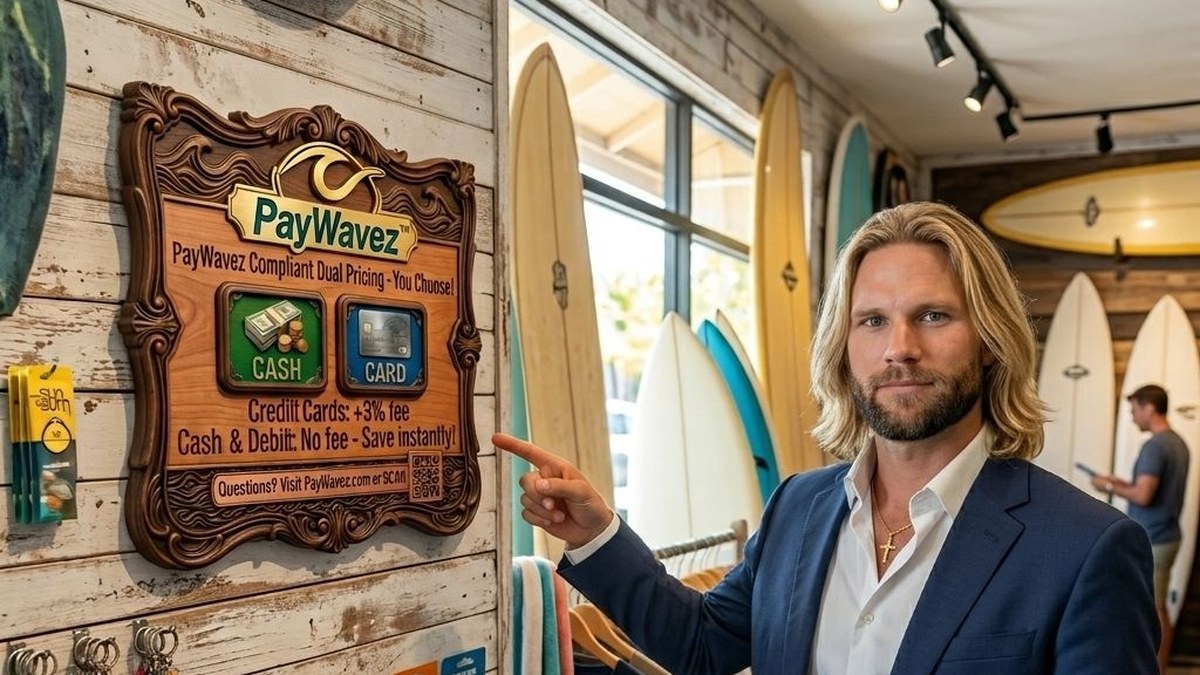
One of the most effective ways to handle the rising cost of bank fees is to implement a surcharging or dual-pricing program. Instead of the business owner absorbing the 3% fee, the cost is passed on to the customer who chooses the convenience of using a credit card. This has become increasingly popular across the United States, especially in service-heavy regions like the Gulf Coast. If you are curious about the specific rules in your area, our Alabama payment processing guide details the legal requirements for signage and notification.
Dual pricing is often the preferred method because it offers a "cash price" and a "card price." This incentivizes customers to pay with cash or debit while ensuring the business owner doesn't lose money on credit card transactions. When implemented correctly with the right POS system, this can virtually eliminate your processing fees, leaving you to pay only a small monthly software fee rather than thousands in transaction costs.
How to Audit Your Merchant Statement for Hidden Fees
Beyond the standard transaction fees, many banks and processors hide additional costs in the fine print. You should look for "PCI Non-Compliance Fees," which can be as high as $100 per month if you haven't filled out your annual questionnaire. Also, watch out for statement fees, gateway fees, and "minimum monthly discount" fees. These are junk fees designed to pad the processor's profit margin.
A healthy merchant account should be transparent. If your statement is twenty pages long and filled with codes you don't understand, there is a high probability you are being overcharged. We recommend doing a side-by-side comparison at least once a year to ensure your processor hasn't slowly crept your rates upward. In conclusion, while the question of how much do banks charge merchants for credit card transactions has a complex answer, staying informed is your best defense against high costs. For a more high-level summary, revisit our post on how much are card processing fees.
Ready to see your own numbers?
Run your real card volume through the calculator or apply in about two minutes.