
Fees & Rates
How Much Are Card Processing Fees? A Clear Guide for Small Businesses
Understanding exactly how much you pay per transaction is the first step to keeping more of your hard-earned revenue and choosing the right partner for your business.

How much are card processing fees is a question that keeps many small business owners up at night. When you look at your monthly merchant statement, it often feels like you are reading a different language. There are percentages, per-transaction costs, and monthly service charges that seem to come out of nowhere. For a small business, every penny counts. If you are operating a retail shop or a restaurant, those small fees can add up to thousands of dollars by the end of the year. Whether you are running a shop in the Alabama payment processing market or selling products online, knowing where your money goes is vital.
The Three Main Parts of a Processing Fee
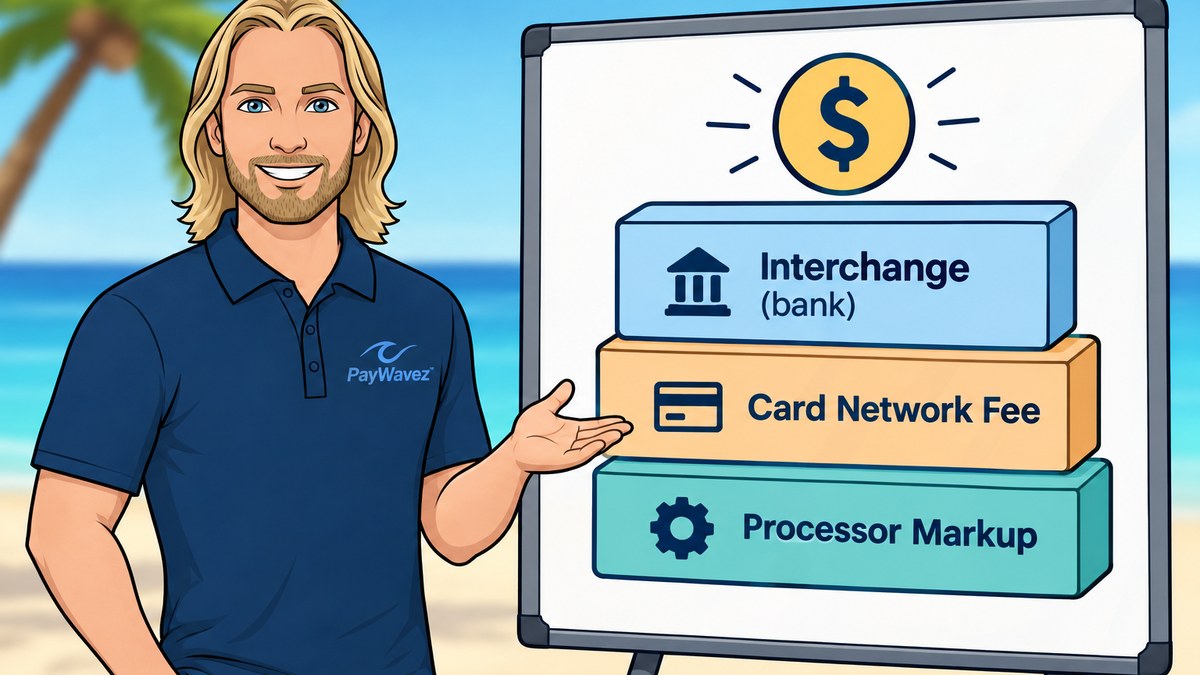
To understand the total cost, you have to look at the three layers of every transaction. No matter which processor you use, these three groups are getting a piece of the pie. The first part is the interchange fee. This is the largest portion of the cost. This money goes directly to the bank that issued the customer's card, like Chase or Wells Fargo. The rates for interchange are set by the card brands (Visa, Mastercard, etc.) and are the same for every processor. No processor can negotiate these rates.
The second part is the assessment fee. This small fee goes directly to the card brands themselves. Visa and Mastercard charge this for the right to use their network. Like interchange, these are non-negotiable. Finally, there is the processor markup. This is the only part of the fee that is actually negotiable. This is how companies like PayWavez or Square make money to provide you with equipment and support. When people ask about the total cost, they are usually looking at the combination of these three factors.
Key Takeaway: The average effective rate for a small business typically falls between 2.5% and 3.5%, but this can vary wildly based on how you take payments and what cards your customers use.
Flat-Rate vs. Interchange-Plus Pricing
When you start looking for a provider, you will usually see two main pricing models. Flat-rate pricing is very popular with new businesses. Companies like Square or Stripe use this. They might charge you a flat 2.6% plus 10 cents for every swipe. This is easy to understand, but it is often the most expensive way to process payments. Why? Because some cards, like basic debit cards, cost much less than 2.6% to process. With a flat rate, the processor keeps the extra profit.
Interchange-plus pricing is generally considered the most transparent model. In this setup, the processor passes the exact cost of interchange and assessments through to you, then adds a small, fixed markup. This means when a customer uses a low-cost debit card, you pay less. If they use a high-rewards travel card, you pay a bit more. Over time, interchange-plus usually saves a business owner a significant amount of money compared to flat-rate pricing. If you want to see how this looks in action, you can check out a live demo of how modern systems handle these calculations.
How Much Are Card Processing Fees for Different Card Types?
Not all cards are created equal. This is one of the biggest surprises for new business owners. A standard debit card is the cheapest card to process. This is because the risk is low and the bank is simply moving money that already exists in a checking account. On the other hand, a premium rewards credit card or a corporate card can be very expensive. The banks charge higher interchange fees on these cards to pay for the "free" flights and cash back they give to the cardholders.
The way you take the payment also matters. A "card-present" transaction, where you swipe, dip, or tap the card at a physical terminal, has the lowest fees. This is because the risk of fraud is much lower when the merchant can physically see the customer and the card. "Card-not-present" transactions, such as online orders or over-the-phone payments, carry higher fees. Banks charge more for these because there is a higher chance of a chargeback or a fraudulent transaction occurring.
"Small business owners often focus on the headline rate, but the real cost is hidden in the effective rate—the total fees divided by the total volume."
Hidden Fees to Watch Out For on Your Statement
Beyond the percentages, many processors hide extra costs in the fine print. These are often called "junk fees." One common example is the PCI compliance fee. While every business must be PCI compliant, some processors charge a monthly fee just to "manage" it for you. Others might charge a "statement fee" just to send you a PDF of your bill. There are also batch header fees, which are charged every time you close out your terminal at the end of the day.
If you are a local business, say a fishing charter in Gulf Shores, you might see these fees eating into your seasonal profits. It is important to ask for a fee schedule before you sign any contract. A transparent processor will list every possible charge upfront. If they won't give you a straight answer about monthly minimums or annual fees, it is a major red flag. You should always look for a partner that offers month-to-month agreements rather than long-term locked-in contracts.
The Dual Pricing Revolution: How to Pay $0 in Fees
One of the biggest shifts in the industry is the move toward dual pricing. This is a legal and transparent way to eliminate your processing costs entirely. In a dual pricing model, your POS system displays two prices for every item: a cash price and a card price. If a customer pays with a card, the processing fee is built into that price. If they pay with cash, they receive a discount. This effectively shifts the cost of the processing from the business owner to the consumer who chooses the convenience of using a card.
This is different from a surcharge, which is often added as a surprise at the end of the transaction. Dual pricing is much more customer-friendly because the pricing is clear on the shelf or the menu. For many small businesses, switching to this model is the fastest way to increase their profit margins by 3% or more overnight. It allows you to stop worrying about fluctuating interchange rates because you are no longer the one paying them.
How to Calculate Your Effective Rate
If you want to know the truth about your costs, you need to calculate your effective rate. Do not just look at the "qualified rate" on your statement. Processors often highlight a low rate that only applies to a tiny fraction of your transactions. To find your true cost, take the total amount of fees you paid for the month and divide it by the total dollar amount of sales you processed. Then, multiply by 100.
For example, if you processed $10,000 in sales and your total fees were $350, your effective rate is 3.5%. If that number is higher than 4%, you are almost certainly overpaying. This simple math allows you to compare different processors fairly. It cuts through the marketing fluff and shows you exactly what is leaving your bank account every month. Many owners find that once they do this math, they are shocked at how much they are actually losing to hidden markups.
Why Local Support Matters for Your Bottom Line
When something goes wrong with your terminal on a busy Saturday, you don't want to be stuck on hold with a call center in another country. Having a local partner can save you money by preventing downtime. A processor that understands your specific market can also help you set up your equipment to avoid "downgrades." A downgrade happens when a transaction doesn't meet certain security criteria, causing the bank to charge a higher interchange rate. Proper setup and training can prevent these costly errors.
Ready to see your own numbers?
Run your real card volume through the calculator or apply in about two minutes.