
Fees & Rates
Affordable Merchant Services: How to Stop Overpaying for Credit Card Processing
Finding affordable merchant services shouldn't feel like a game of hide-and-seek with your own money; here is how to find a partner that actually helps your bottom line.
Affordable merchant services are more than just a low rate; they are a transparent partnership that helps your business grow. Many small business owners start their journey by looking for the lowest percentage they can find on a website, but they quickly realize that the base rate is only one piece of the puzzle. If you are looking for a comprehensive look at the market, you should also check out our guide on the best merchant services for small business to see how different providers stack up.
Understanding the True Cost of Processing
When people search for affordable merchant services, they are usually trying to escape the high costs of "flat-rate" processors. While a flat 2.6% plus 10 cents sounds simple, it is often the most expensive way to run a business once you scale. True affordability comes from understanding the three components of every credit card transaction: the interchange fee (set by banks), the assessment fee (set by card brands like Visa), and the processor's markup.
An affordable provider will offer you "Interchange-Plus" pricing. This means they pass the wholesale cost of the transaction directly to you and only charge a small, transparent margin on top. This is much cheaper than flat-rate pricing for businesses that process a mix of debit cards and basic credit cards, which have much lower wholesale costs than premium rewards cards.
How to Identify Affordable Merchant Services for Your Niche
Not every business has the same needs. A coffee shop in Gulf Shores has a very different transaction profile than a high-end furniture store. To find the right fit, you need to look at your average ticket size. If your average sale is $5, a 30-cent per-transaction fee will eat your profits alive. If your average sale is $500, that 30 cents doesn't matter as much as the percentage rate does.
Affordable merchant services should also offer hardware that fits your workflow without a massive upfront cost. Whether you need a simple handheld terminal or a full POS system, the cost of the equipment should be clear. Beware of providers that offer "free" equipment; these often come with long-term contracts and higher monthly fees that cost you thousands more over time than if you had just bought the terminal outright.
According to industry analysis, businesses that switch from flat-rate pricing to interchange-plus pricing save an average of 18% to 24% on their total monthly processing costs.
The Power of Dual Pricing and Surcharging
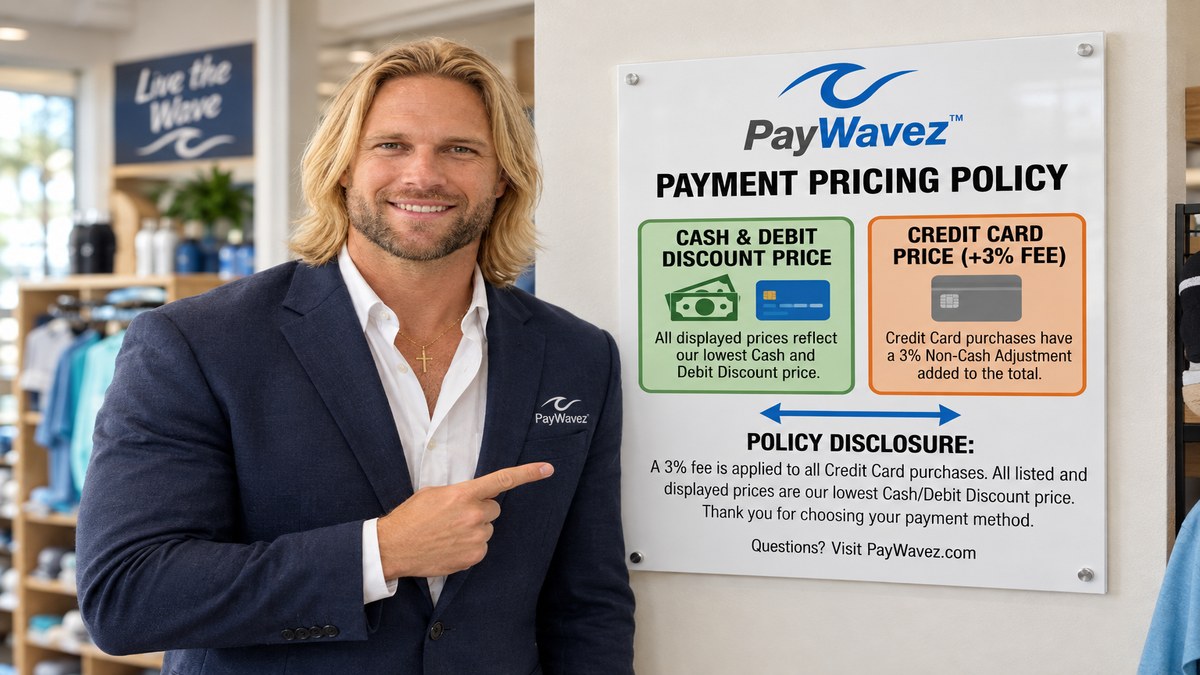
One of the most effective ways to make your merchant services truly affordable is to look into dual pricing or surcharging. These programs allow you to pass the cost of credit card processing on to the customers who choose the convenience of paying with plastic. In a dual pricing model, your shelf prices are the credit price, and customers who pay with cash receive a discount. This effectively brings your processing cost down to nearly zero.
At PayWavez, we specialize in setting up these programs legally and transparently. We ensure you have the right signage and that your terminal is programmed to handle the math automatically. This is a game-changer for small businesses in the Alabama payment processing market, where margins are tight and every penny counts. You can see how this works in real-time by viewing our live demo.

Avoiding the "Junk Fee" Trap
Many processors hook you with a low rate and then bleed you dry with "junk fees." To keep your merchant services affordable, you must look at your monthly statement for these common culprits:
- PCI Non-Compliance Fees: These can be $30 to $100 a month. A good processor will help you become compliant so you never have to pay this.
- Monthly Minimums: If you don't process enough, some companies charge you a penalty.
- Statement Fees: Some companies still charge $10 or $15 just to send you a digital bill.
- IRS Reporting Fees: A fee just for the processor to do the paperwork they are legally required to do anyway.
Don't let a low teaser rate blind you to the hidden costs of a bad merchant agreement; the real price is found in the fine print of your monthly statement.
The Role of Local Support in Affordability
You might wonder why a local company is often more affordable than a giant national brand. The answer is service. When your terminal goes down on a busy Saturday, every minute of downtime is lost revenue. A national brand might put you on hold for an hour. A local partner provides faster support, ensuring you don't lose sales. Affordability isn't just about the rate; it's about the total cost of ownership, which includes the cost of downtime and frustration.
Protecting Your Revenue from Chargebacks
A single chargeback can wipe out the profit from twenty sales. Affordable merchant services should include tools to help you fight and prevent chargebacks. This includes using EMV chip readers for every transaction and having a system that captures digital signatures. If your processor doesn't provide you with the tools to defend your revenue, they aren't actually affordable in the long run.
Conclusion: Choosing Your Partner Wisely
Finding affordable merchant services is a journey of education. By focusing on interchange-plus pricing, considering dual pricing models, and avoiding junk fees, you can significantly reduce your overhead. Remember that the cheapest option on paper isn't always the best for your specific business. For a deeper dive into the top providers in the industry today, revisit our analysis of the best merchant services for small business. With the right partner, you can stop worrying about your fees and start focusing on what you do best: serving your customers.
Ready to see your own numbers?
Run your real card volume through the calculator or apply in about two minutes.