

Getting Started
How long does merchant account approval actually take?
Underwriting timelines vary a lot by processor and business type. Here's what actually happens behind the scenes, and why it can take minutes instead of days.

“How fast can I start taking cards?” is one of the most common questions a new merchant asks, and the honest answer is: it depends entirely on how the processor's underwriting is built. Traditional applications and modern instant-boarding flows can produce very different timelines for the exact same business.
What underwriting is actually checking
Every legitimate payment processor has to verify who you are and what kind of business you're running before approving you to accept cards — this is a card network and banking requirement, not optional paperwork. That generally means confirming business identity and ownership, checking the business type against card network risk categories, and verifying banking details so funds land in the right account. How that verification happens — manual document review versus automated identity and business-data checks — is what actually determines your timeline.
Why traditional applications can take days
Older-style merchant applications often route through a manual underwriting queue: you fill out a paper or PDF application, submit supporting documents, and a human underwriter reviews the file — sometimes requesting additional documentation before making a decision. Depending on the processor's staffing and backlog, that manual review can take anywhere from a same-day turnaround to several business days, and any missing document or follow-up question restarts part of the clock.
How instant boarding compresses that timeline
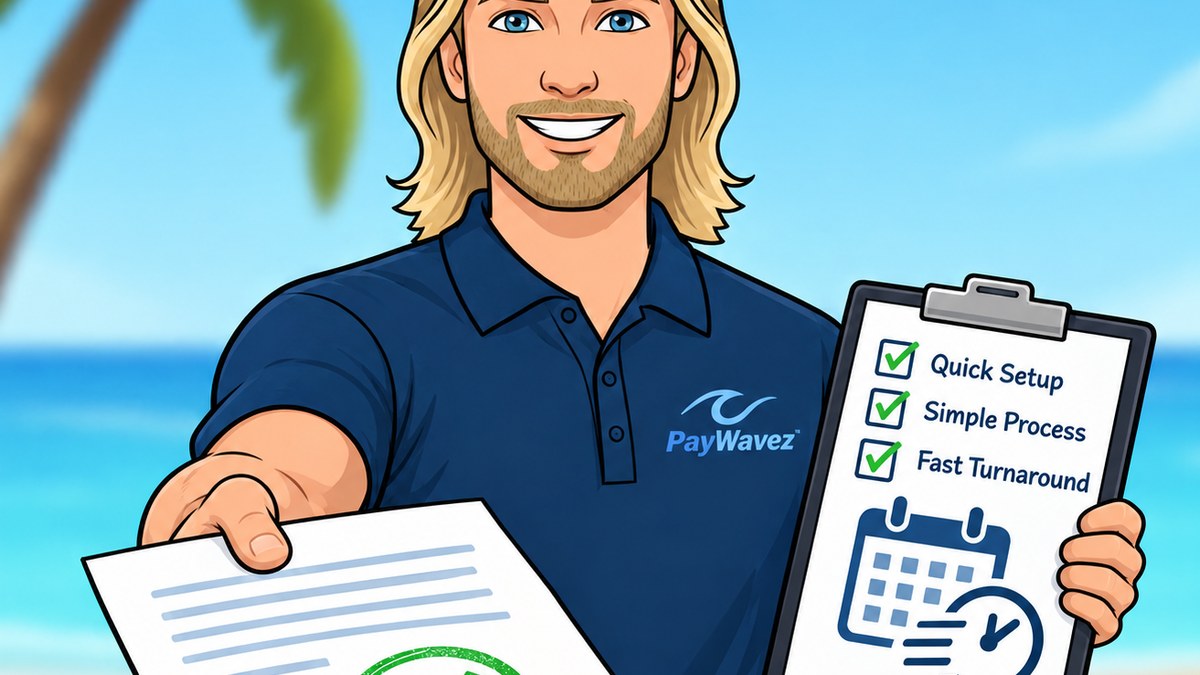
PayWavez's onboarding is built around 2-Minute Instant Boarding: moving through identity verification and starting to accept payments in as little as two minutes. Instead of a manual document queue, the application walks you through identity and business verification digitally, and straightforward applications can clear underwriting almost immediately. More complex business types — higher-risk categories, unusual ownership structures, or businesses that need additional documentation — may still take longer, since the underlying verification requirements don't disappear just because the process is faster. But for a typical small business applying with accurate information on hand, instant boarding is designed to remove the multi-day wait rather than shortcut the actual verification.
Why business type still affects the timeline
Underwriting isn't just about verifying who you are — it's also about classifying what kind of business you're running against card network risk categories. A standard retail shop, service business, or restaurant is usually the fastest category to clear, since the risk profile is well understood and documentation requirements are minimal. Businesses in higher-risk categories — certain subscription models, high-ticket goods, or specialty industries — may need additional documentation regardless of how fast the underlying technology is, because that documentation is a card network requirement tied to the business type itself, not a processor-imposed slowdown.
What speeds your own approval up
Regardless of processor, having your business's legal name, EIN or SSN, banking information, and a clear description of what you sell ready before you start the application is the single biggest factor in avoiding delays — most holdups come from incomplete or mismatched information rather than the underwriting process itself. If your business falls into a category that requires extra documentation, having that ready upfront (rather than after a request comes back) is what keeps even a fast instant-boarding flow moving at its fastest pace.
What does merchant underwriting actually check?
It verifies your business identity and ownership, checks your business type against card network risk categories, and confirms your banking details so funds settle to the right account. This verification is required by the card networks, not optional paperwork a processor adds on its own.
Why do some merchant applications take several days?
Traditional applications that route through a manual underwriting queue depend on a human reviewer's schedule and backlog, and any missing document or follow-up question can add more time before a decision is made.
What is 2-Minute Instant Boarding?
It's PayWavez's onboarding flow: moving through identity verification and starting to accept payments in as little as two minutes for straightforward applications, replacing a manual document queue with a digital verification process.
Does instant boarding skip any of the required verification?
No. The same identity and business verification requirements apply — instant boarding simply completes that verification digitally and quickly rather than shortcutting it. More complex business types may still take longer if additional documentation is required.