
Fees & Rates
Enterprise Business Payment Solutions for Modern Merchants
Scaling your business requires more than just a simple card reader; it demands a robust infrastructure that handles high volume without eating your margins.

Enterprise business payment solutions are no longer reserved for Fortune 500 companies; they are now essential tools for any growing small business that processes a high volume of credit card transactions. As your sales grow, the simple flat-rate processing you started with can become a massive financial drain. Transitioning to an enterprise-grade setup allows you to take control of your merchant account, reduce processing fees, and implement smarter technology like integrated POS systems and automated surcharging. For many business owners in the US, moving away from basic aggregators to a dedicated merchant account is the first step toward true financial efficiency.
Understanding Your Merchant Account Options
When you first started, you might have used a payment service provider (PSP) that bundles all its clients into one giant merchant account. While this is easy to set up, it lacks the stability and lower costs of a dedicated merchant account. Enterprise business payment solutions provide you with your own unique merchant identification number (MID). This means your funds are not pooled with other businesses, reducing the risk of sudden account freezes or holds. A dedicated account also gives you more leverage to negotiate interchange-plus pricing, which is almost always cheaper than flat-rate pricing for businesses doing more than $20,000 a month in card sales.
Having your own account also means you have a direct relationship with your processor. Instead of waiting in a generic chat queue, you get support that understands your specific business model. This is especially important for businesses on the Gulf Coast that deal with seasonal surges. Whether you are running a high-traffic retail shop or a busy restaurant, your merchant account needs to be as reliable as your front-door lock. You can see how these systems look in action by viewing our live demo.
Deciphering Processing Fees and Interchange-Plus
The biggest hurdle for most business owners is understanding where their money is going. Every time a customer swipes a card, several entities take a cut. The largest portion is the interchange fee, which goes to the bank that issued the customer's card. On top of that are assessment fees from the card brands (Visa, Mastercard) and the processor's markup. Enterprise business payment solutions typically use an "interchange-plus" model. This means you pay the exact cost of the interchange fee plus a small, transparent markup to the processor. This is much more cost-effective than flat-rate models where the processor pockets the difference when a customer uses a low-cost debit card.
According to industry data, businesses that switch from flat-rate processing to interchange-plus pricing can save an average of 18% to 22% on their total monthly processing costs.
It is also vital to watch out for "hidden" fees. Many processors will hide costs in categories like "PCI non-compliance fees," "statement fees," or "minimum monthly fees." When you move to a more professional payment setup, these junk fees should be eliminated or clearly disclosed. Transparency is the hallmark of a quality enterprise solution.
The Power of Surcharging and Cash Discount Rules
One of the fastest ways to lower your overhead is through surcharging or cash discount programs. These enterprise business payment solutions allow you to pass the cost of credit card processing directly to the customer or offer a discount for those who pay with cash. However, you must follow strict legal guidelines to do this. In the US, surcharging is generally allowed but is limited to credit cards only (never debit cards) and is usually capped at 3% or the actual cost of processing.
Cash discount programs are slightly different and often easier to manage. In this model, you display a "service price" for all items, and customers who pay with cash receive a discount at the register. This is a popular option for businesses in tourist-heavy areas like Destin, where high volume means high fees. By implementing these programs correctly, a business can effectively bring their credit card processing costs down to near zero.
"The goal of an enterprise payment strategy isn't just to accept cards; it's to protect your bottom line by eliminating unnecessary middleman costs."
Upgrading Your Terminals and POS Systems
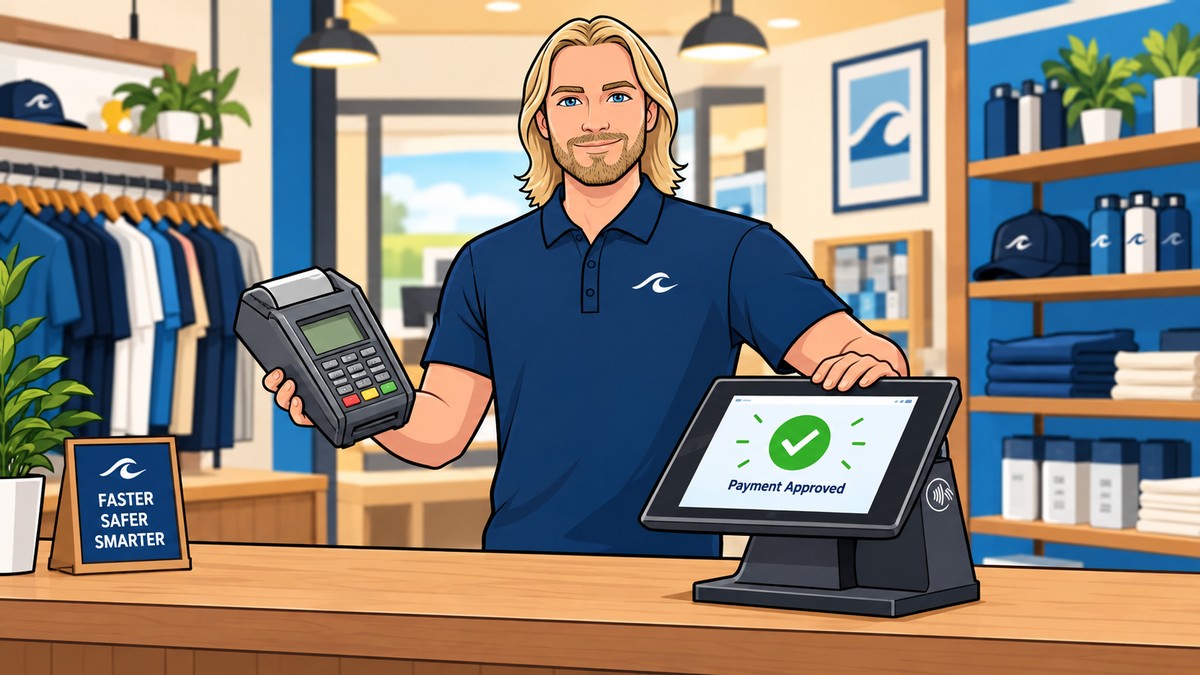
Your hardware is the face of your payment process. Modern enterprise business payment solutions utilize smart terminals and integrated Point of Sale (POS) systems that do more than just take money. These systems track inventory, manage employee hours, and provide deep analytics on your sales trends. Whether you need a rugged countertop terminal for a hardware store or a mobile handheld unit for tableside ordering, the hardware must be EMV-compliant to protect you from fraud liability.
Contactless payments, such as Apple Pay and Google Pay, are now a consumer expectation. If your terminal doesn't support "tap-to-pay," you are likely frustrating your customers and slowing down your checkout lines. High-quality POS systems also integrate directly with your accounting software, saving you hours of manual data entry every week. For businesses across the region, from small boutiques to large service companies, having the right hardware is a competitive advantage. You can explore our regional service areas on our locations hub.
Managing Chargebacks and Fraud Prevention
As your volume increases, so does the risk of chargebacks. A chargeback occurs when a customer disputes a transaction with their bank, and the funds are forcibly pulled from your account. Enterprise business payment solutions include robust fraud prevention tools to help stop these before they happen. This includes Address Verification Service (AVS) and Card Verification Value (CVV) checks for card-not-present transactions.
When a chargeback does happen, you need a processor that helps you fight it. This involves providing proof of delivery or a signed receipt. Many small business owners lose chargebacks simply because they don't have an organized way to submit evidence. An enterprise-level merchant portal makes this process much easier, allowing you to upload documents directly and track the status of the dispute. Remember, too many chargebacks can lead to your merchant account being terminated, so prevention is key.
Why Choose Enterprise Business Payment Solutions for Growth
Choosing enterprise business payment solutions is about more than just finding a lower rate; it's about building a foundation for growth. When your payment system is integrated, transparent, and scalable, you can focus on running your business instead of worrying about your merchant statement. These solutions provide the data you need to make informed decisions about staffing, inventory, and expansion.
For US small business owners, the transition from a "starter" processor to an enterprise-grade solution is a rite of passage. It signals that your business is no longer just a hobby or a side project—it is a serious operation that demands professional tools. By focusing on interchange-plus pricing, leveraging surcharging laws, and utilizing modern POS hardware, you can keep more of your hard-earned money and provide a better experience for your customers.
Ready to see your own numbers?
Run your real card volume through the calculator or apply in about two minutes.